
Explained: What is Lord's slope, and how does it impact cricket at the venue?

(Courtesy : Getty Images)
The current Lord’s Cricket Ground was built in 1814.
One of the most famous locations in cricket’s history is London’s Lord’s Cricket Ground, which is frequently referred to as the “Home of Cricket.” It is well-known for its elegance, tradition, and the Pavilion. It also has a distinctive physical feature: the slope.
Although the Lord’s slope is not particularly noticeable, it has enough impact to affect games played at this storied location. Lord’s, which can accommodate more than 30,000 people, is a hallowed location for both players and spectators because it blends classic charm with contemporary conveniences.
The Marylebone Cricket Club (MCC) owns Lord’s, which was founded in 1814 and is more than just a stadium; it is a representation of cricket’s history. It has played host to several significant events, such as World Cup finals and Ashes classics.
Catch Every Update, Anytime, Anywhere
What exactly is the Lord’s slope?
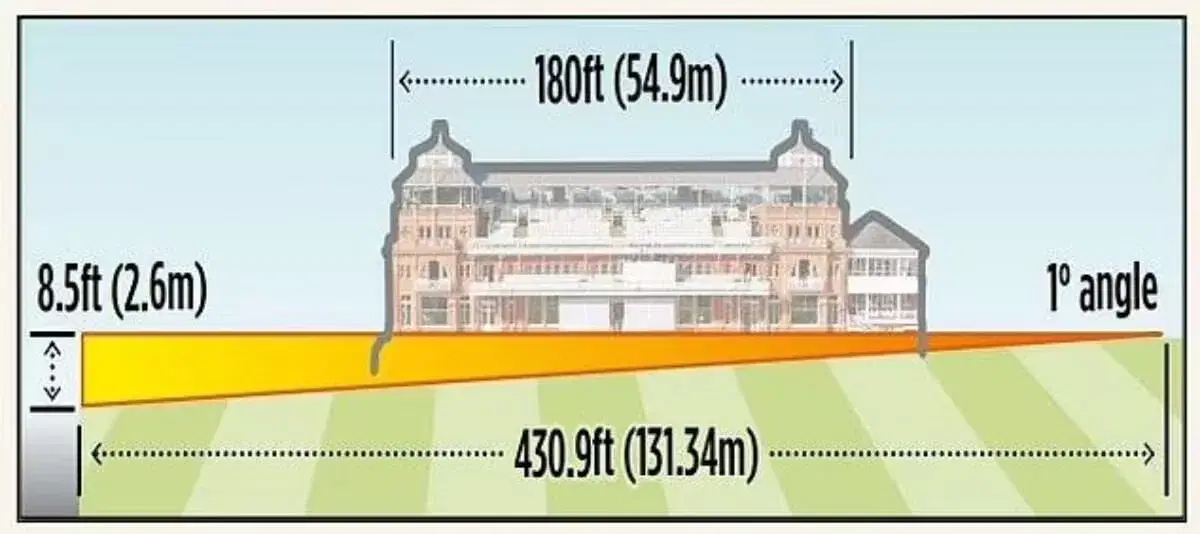
Beyond its attractive surroundings and illustrious history, however, is a peculiarity: a hill that crosses the playing field. The Lord’s slope is a naturally occurring incline that descends roughly 2.5 meters (8 feet 2 inches) from Pavilion End in the northwest to Nursery End in the southeast.
This slope has been there since the beginning of the ground and hasn’t been altered to maintain the venue’s distinct personality.
The 2.5-meter inclination that runs the length of the playing field, not along the pitch but rather from side to side, is known as the Lord’s slope. It indicates that the pitch is much higher on one side than the other.
Due to worries about destroying the ground’s drainage and historical character, this topographical feature was never flattened; rather, it is a naturally occurring component of the topography.
Even while the drop might not appear significant, it has a significant impact on how games at the Lord’s turn out. The ball’s behavior in the air, off the ground, and even in the field is influenced by the slope. It’s a particular difficulty at this location that bowlers and hitters need to consider.
How does the slope help the bowlers?
For bowlers, the slope can be a tactical tool, particularly for seamers and swing specialists. Because the slope pulls the ball downhill, right-arm bowlers who operate from the Pavilion End have an advantage when they slant the ball toward the right-hander and allow it to seam or swing away.
On the other hand, left-arm pacers can take advantage of it from the Nursery End, causing the ball to drift unnaturally away from left-handers or dart into right-handers.
Spinners are not excluded either. Depending on the wind and pitch conditions, leg-spinners may benefit from more bounce and turn from the other end, while off-spinners bowling from the Pavilion End can exploit the slope to help drift and drop.
In essence, the slope gives bowlers a layer of variation and deceit that they can eventually learn to manage.
How do batters deal with the slope?

The Lord’s slope is a technical and mental test for batters. Normally, missing balls may suddenly swing or seam sufficiently to strike the pads or uproot stumps. Likewise, deliveries drifting away can tempt batters into misleading shots, especially against the swing.
Players’ footwork becomes crucial; they need to use accurate judgment outside of off-stump, especially early in the innings when the bowlers try to take advantage of the slope’s assistance. The choice of shot also varies; hitters may refrain from dangerous drives until they feel comfortable gauging the effect of the slope.
Because the ball frequently rolls erratically toward the boundary or stalls on the uphill side, even racing between the wickets can be challenging.
Does the slope benefit anyone?
The slope is neutral in and of itself; it helps players who learn to use it, not just one team or player regularly. Due to familiarity, local players—like bowlers from England—frequently have an advantage.
Early in the tour, visiting teams—particularly subcontinental sides—may have trouble adjusting to the lateral movement that the slope can help with.
Actually, despite generally having outstanding form, debutants or players without any Lord’s experience may do poorly due in part to the hill. Both literally and symbolically, it creates a learning curve.
Lord’s slope is a unique aspect of contemporary cricket that gives the game flair and complexity. It turns a field that is already iconic into a strategic battlefield where minor changes can decide matches and careers.
Learning the slope is as much of a rite of passage for players as actually playing at Lord’s. It serves as a reminder to cricket enthusiasts that the game may be influenced by anything, including the ground beneath your feet.
When was the Lord’s Cricket Ground built?
Lord’s Cricket Ground was built in 1814.
What is the Lord’s slope?
The Lord’s slope is a naturally occurring incline that descends roughly 2.5 meters (8 feet 2 inches) from Pavilion End in the northwest to Nursery End in the southeast.
What is the Lord’s frequently referred to?
The Lord’s is frequently referred to as the “Home of Cricket.”
For more updates, follow Khel Now Cricket on Facebook, Twitter, Instagram, Youtube; download the Khel Now Android App or IOS App and join our community on Whatsapp & Telegram.