
Messi Tour 2025: Sports carnival or a politically driven agenda?
Some fans reportedly spent close to ₹10 lakh for a single photograph with visiting football legends during the Messi Tour 2025.
The announcement of the Messi Tour 2025 had sparked excitement that extends well beyond the footballing world. For fans, it promises a rare spectacle, global star power, and a celebration of the beautiful game on an unprecedented scale. For experts, however, the tour raises uncomfortable questions about intent, timing, and influence.
Messi’s visit had the entire country talking, with lavish spending directed at every aspect of his presence, from extensive security arrangements to a grand reception and heavily promoted fan interactions at stadiums.
The tour, however, began on a disastrous note in Kolkata. The atmosphere appeared perfect as Messi walked into a packed stadium, with thousands of fans eagerly anticipating a once in a lifetime moment.
Many supporters had paid over ₹4,000 for tickets, with some shelling out five figure sums, simply for the chance to catch a glimpse of their idol.
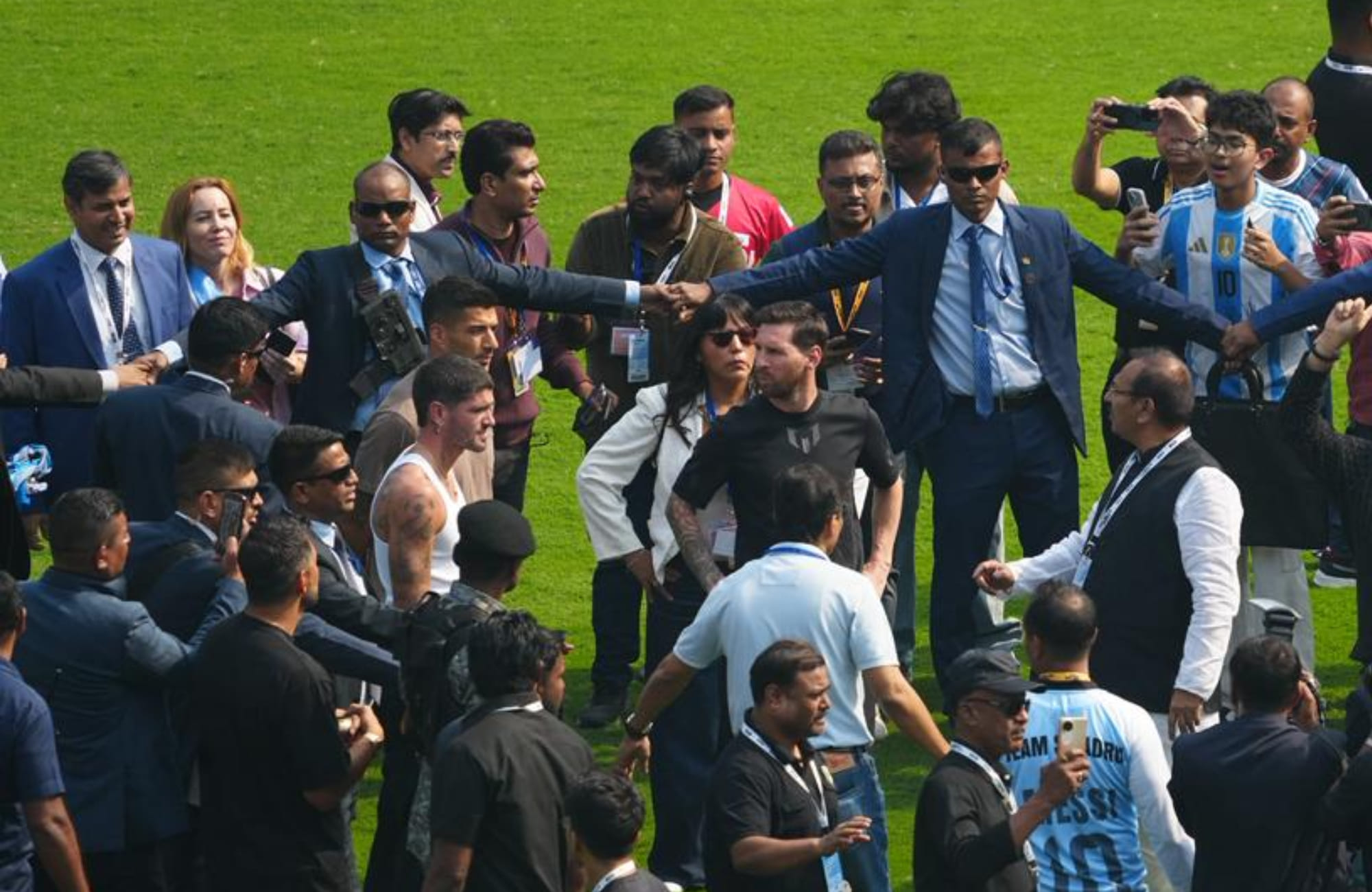
But within seconds of his arrival, the situation spiralled out of control. Nearly 60 to 70 people, largely comprising media personnel, politicians, and their family members, surrounded the Argentine on the field.
Also Read: Sunil Chhetri pens heartfelt message after meeting Lionel Messi in GOAT India Tour 2025
In a moment that drew widespread criticism, West Bengal Sports Minister Aroop Biswas was seen pulling Messi aside for photographs and selfies, even as the footballer appeared keen to engage with the fans who had filled the stadium to see him.
After nearly ten minutes of chaos on the field, with the situation clearly spiralling out of control, Messi’s security team escorted him and the two other stars off the ground.
What began as unbridled excitement quickly turned into anger and frustration among the fans. Disturbing scenes followed, as the so called Mecca of Indian football descended into mayhem, with bottles hurled onto the field, chairs uprooted, and sections of the stadium vandalised.
Also Read: ISL clubs submit consortium proposal to the AIFF and Ministry of Youth Affairs and Sports
Although the TMC government later promised action, the damage had already been done, and India’s reputation took a significant hit. The remaining legs of the tour were largely successful, with Mumbai and Delhi in particular delivering well managed spectacles that kept the spotlight firmly on the real star, Messi.
The crowd at the Wankhede Stadium offered a stark reality check for those seeking attention. Each time Chief Minister Devendra Fadnavis took the microphone, a chorus of boos from nearly 30,000 fans rang out. Even Bollywood celebrities Ajay Devgn and Tiger Shroff were not spared from the crowd’s disapproval.
Yet the central question remains: how does Indian football truly benefit from all this? From Kolkata to Mumbai, and from Hyderabad to Delhi, political leaders repeatedly took centre stage, using the platform for personal publicity.
Telangana Chief Minister Anumula Revanth Reddy even shared the field with Messi, but his inability to execute a simple return pass turned the moment into a global talking point for all the wrong reasons.
In Delhi, Chief Minister Rekha Gupta felicitated Messi against the backdrop of dangerously deteriorating air quality and soaring AQI levels, with sections of the crowd attempting to draw attention to the adverse conditions.
With no shortage of pressing issues demanding governance and accountability, the presence of political leaders alongside Messi only served to underline misplaced priorities.
Adding to the discomfort was the treatment of India’s own footballing icon, Sunil Chhetri. The greatest player the country has produced was made to wear a jersey bearing Messi’s image, a moment that sat uneasily with many fans. Only years earlier, Chhetri had appealed to supporters to fill stadiums and back the national team.
Seeing those same fans now paying twenty times more for a fleeting glimpse of Messi, and spending close to ₹10 lakh for a photograph with three visiting legends, starkly exposes the deep rooted culture of hero worship and the uncomfortable truths about how Indian football values its own.
While crores are being mobilized for a short term spectacle, Indian football is battling one of the worst crises in its history. Both the Indian Super League and the I League currently stand without commercial partners, seasons remain uncertain, and hundreds of professional players are left in limbo.
The domestic football ecosystem is crumbling under administrative inefficiency and lack of vision. Clubs are struggling to pay salaries, youth development pathways are blocked, and support staff face growing insecurity.
The AIFF’s failure to attract a single bidder for the country’s top two leagues has exposed the fragility of Indian football’s commercial model.
At a time when the sport needs urgent investment in infrastructure, governance, grassroots programs, and league stability, resources are instead diverted toward headline grabbing events that offer visibility but no long term value.
Money spent on the Messi Tour could have been transformative if directed toward Indian football welfare. It could have ensured league continuity, strengthened academies, protected player livelihoods, and restored confidence among sponsors and fans.
Instead, Indian football remains dependent on symbolic gestures rather than structural reform. Until priorities shift from spectacle to sustainability, the sport will continue to survive on moments rather than progress.
True growth will not come from watching legends up close for one night, but from building a system where Indian footballers can thrive every season.
What was the Messi Tour 2025 about?
The Messi Tour 2025 featured Lionel Messi visiting multiple Indian cities for fan interactions and public events, drawing massive crowds and nationwide attention.
What went wrong during the Kolkata leg of the tour?
The event in Kolkata descended into chaos when Messi was surrounded on the field by media personnel and politicians, preventing fan engagement and leading to crowd anger and vandalism.
Why did the tour attract criticism despite its popularity?
Critics pointed out the excessive political presence, poor crowd management in certain cities, and the lack of long-term benefits for Indian football.
How were fans affected during the tour?
Many fans paid high ticket prices expecting close interaction with Messi but left disappointed, especially in Kolkata where Messi was escorted off the field early.
For more updates, follow Khel Now on Facebook, Twitter, and Instagram; download the Khel Now Android App or IOS App and join our community on Whatsapp & Telegram

Aniruddh Seshadri Iyer is a passionate sports journalist at Khel Now, specializing in tennis and Olympic sports. An engineer by training, he found his storytelling passion through iconic Grand Slam and Olympic moments. Known for sharp analysis and insightful coverage, he draws inspiration from Novak Djokovic’s resilience. Outside journalism, he enjoys reading, traveling, and playing the guitar.