
AIFF relays 20-year structure plan for organising Indian Super League
AIFF rejected a consortium proposal from ISL clubs earlier.
Following an online meeting with the representatives on Friday, December 26th, the All India Football Federation (AIFF) presented the clubs with a detailed 20-year plan for organising the Indian Super League (ISL).
Under this plan, AIFF will own and operate the league, following a June-to-May cycle, while allowing temporary revenue sharing with clubs and commercial partners. Financially, the league will run on a Central Operational Budget funded by all revenue shareholders. This budget will cover operations, licensing, and prize money, with strict spending limits in place.
Clubs will pay a standard participation fee of Rs 1 crore each season, which will later be reimbursed from central revenues. Governance will be handled by a league board with limited autonomy, while AIFF retains final financial control.
The structure also preserves promotion and relegation to protect sporting merit. Revenue will be shared between AIFF, clubs, and partners, alongside safeguards like fixed revenue shares and parachute payments. However, concerns remain over costs, salary caps, investment security, and the continued uncertainty around the ISL 2025–26 start date.
League ownership and long-term framework
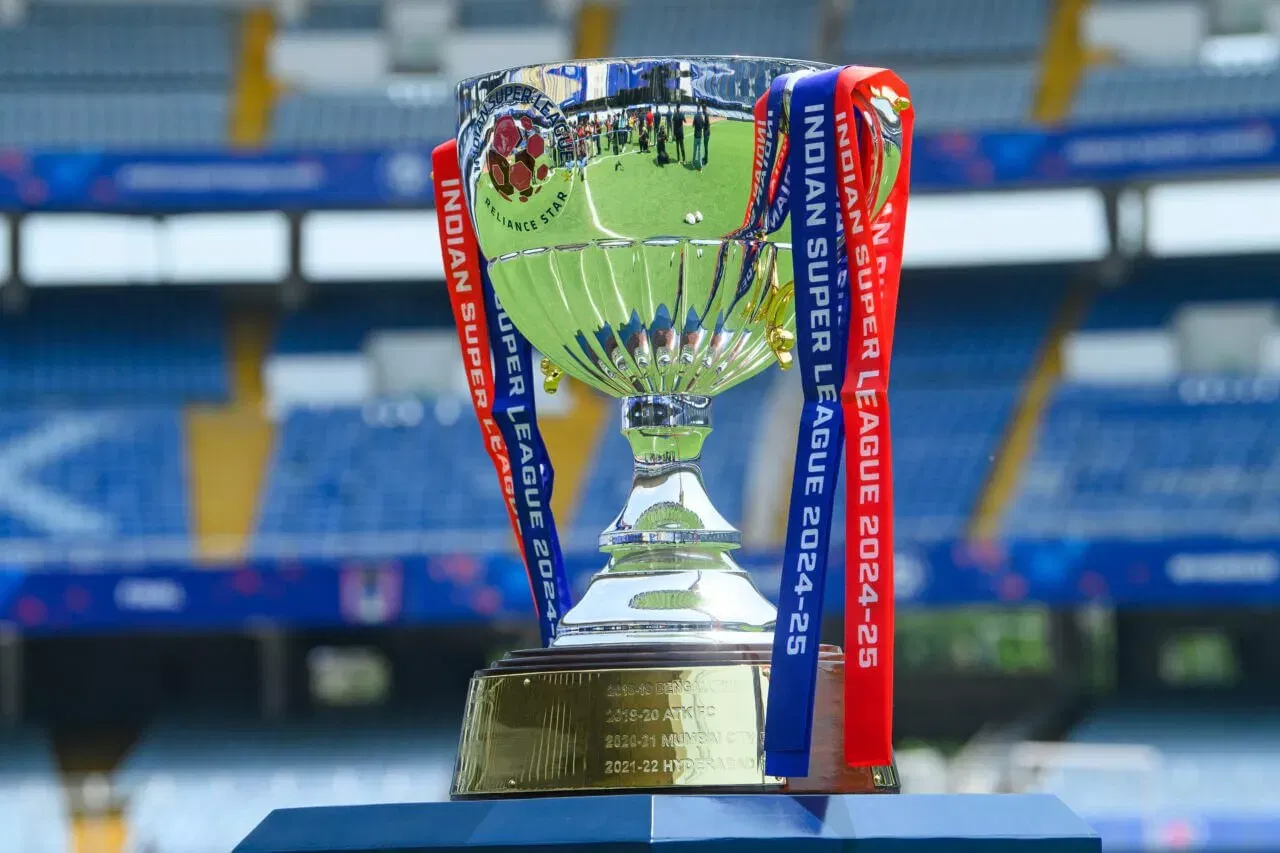
Under the proposal, the Indian Super League (ISL) will be owned and operated by the AIFF. This structure will run for 20 seasons. Each season will follow a June-to-May cycle. After the cycle ends, all revenue shares return to the federation.
As a result, AIFF retains final control. At the same time, it allows temporary revenue sharing with stakeholders. This balance, in theory, protects Indian football from sudden exits by private partners.
Central Operational Budget and yearly planning
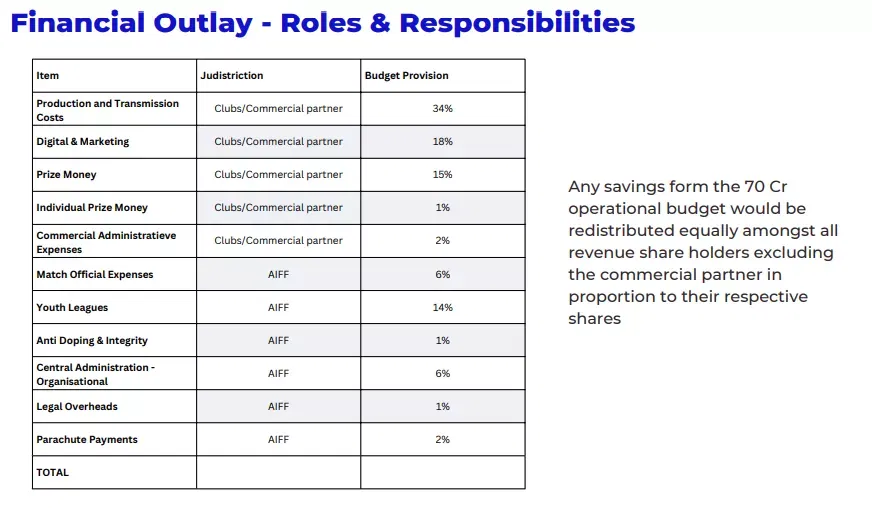
The AIFF plans to introduce a Central Operational Budget every season. All revenue shareholders will contribute to it. These contributions will be proportionate to their revenue shares.
Therefore, the league’s core costs will come from a common pool. This budget will cover operations, licensing compliance, and prize money. Any spending beyond this cap will not be allowed.
Standard participation fee for clubs
Each participating club must pay a standard participation fee of Rs 1 crore per season. Clubs will pay this amount directly to AIFF at the start of the year. Notably, this fee sits outside operational expense calculations.
However, the amount is reimbursable from central revenues before net distribution. In addition, participation fees together will form 20 per cent of the Central Operational Budget.
Governance and board oversight
Governance will sit with a league board empowered by the AIFF General Body. The board will enjoy limited autonomy. Its authority will focus on commercial and operational matters.
Still, AIFF will retain control over unrestricted funds. This ensures oversight while giving room for quicker decisions. For Indian football, this could reduce delays seen in past seasons.
Open league model with promotion and relegation
The proposed structure confirms an open league model. Promotion and relegation across tiers will remain intact. This keeps sporting merit central to the pyramid.
Consequently, clubs from the I-League and lower divisions retain a pathway upward. This principle aligns with AFC norms and long-term Indian football development.
Revenue sharing and stakeholder contributions
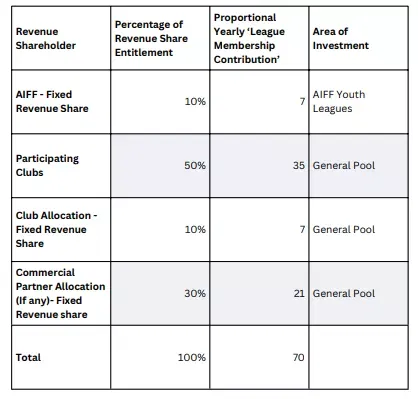
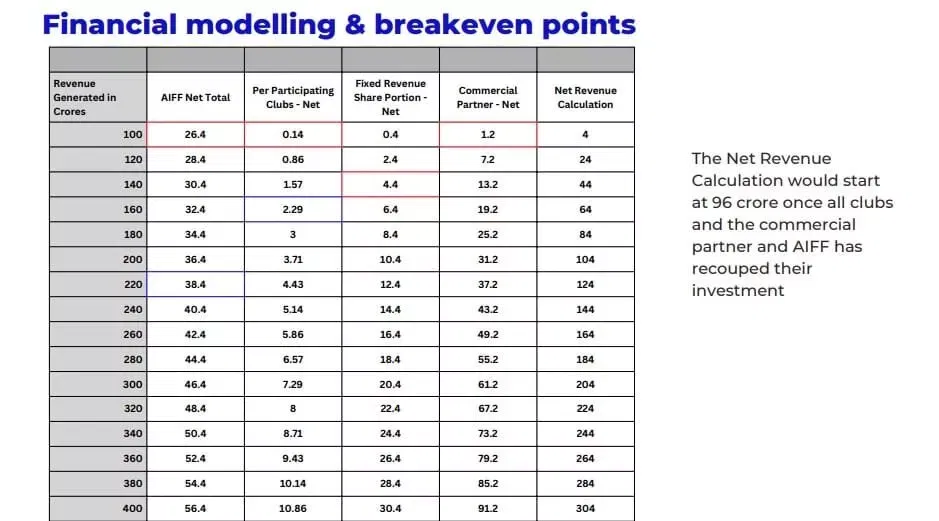
Revenue will be split across AIFF, clubs, and potential commercial partners. AIFF will hold a fixed 10 percent share. Participating clubs will collectively receive 50 percent.
Meanwhile, up to 30 percent can go to a commercial partner. All stakeholders must also pay a League Membership Contribution based on their share.
a. AIFF – 10% ‘Fixed Revenue Share’ would be retainedb. Clubs – 50% revenue share distributed equally amongst participating clubs and an additional optionto hold a ‘Fixed Revenue Share allocation’c. Fixed Revenue Shareholders –i. 30% ‘Fixed Revenue Share’ earmarked for a potential commercial partner.ii.10% ‘Fixed Revenue Shares’ reserved for clubs who would want to invest into an additional ‘RevenueShare’ of the central revenue pool and protect a portion of their investment in the League upon theirrelegation from the League on Sporting Merit.
Protection of club investments
The proposal includes safeguards for existing clubs. Teams with longer participation histories can retain fixed revenue shares even after relegation. However, they must continue paying membership contributions.
Additionally, AIFF plans parachute payments for relegated clubs. This aims to soften financial shocks and protect long-term investments in Indian football.
a. Clubs who’s licenses have had a participation in the League for more than 8 years as on December2025 – Up to 1% of Fixed Revenue Shareb. Clubs who’s licenses have had a participation 3 years or more as on December 2025 – Up to 0.5% ofFixed Revenue Sharec. Clubs who’s licenses have had a participation of 1 to 3 years as on December 2025 – Up to 0.25% FixedRevenue Share
Concerns Raised by ISL clubs
Despite its structured outlook, the proposal has triggered several concerns among clubs and stakeholders. First, operational expenses remain unclear. While the Central Operational Budget sets a cap, clubs want clarity on cost distribution and real spending limits.
Second, the absence of a defined salary cap framework has raised alarms. Clubs fear uneven spending could return if limits are not clearly enforced. This issue is expected to be a major talking point.
Finally, long-term protection of investments remains unresolved. Although fixed revenue shares and parachute payments offer some security, clubs want stronger guarantees if commercial revenues fall. Most importantly, timelines remain uncertain. Even AIFF president Kalyan Chaubey has not confirmed when ISL 2025–26 will begin.
What is AIFF’s proposed super structure for the ISL?
AIFF plans to own and operate the top-tier league for 20 seasons, with a fixed governance and financial framework. The model includes shared revenues, a central budget, and promotion and relegation. The proposal covers a 20-season cycle, with each season running from June to May. After this period, revenue shares will return fully to AIFF.
How much will clubs pay to participate?
Each club must pay a standard participation fee of Rs 1 crore per season. This amount will be reimbursed from central revenues before net distribution.
For more updates, follow Khel Now on Facebook, Twitter, Instagram, Youtube; download the Khel Now Android App or IOS App and join our community on Whatsapp & Telegram.

A sports journalist for over 4 years, Triyasha has been covering Indian Football and Kanbaddi meticulously, She specialises in in-depth knowledge of the game, the players and the footballing infrastructure and heritage in India.
- IWL 2025-26 Round 3 preview: East Bengal FC face Garhwal United FC test with bragging rights at stake
- AIFF Appeals Committee sets aside PSC orders in Anwar Ali dispute, sends case back for fresh hearing
- Fulham's Marco Silva gives Harry Wilson injury update ahead of West Ham Premier League clash
- Manchester United vs Newcastle United: Live streaming, TV channel, kick-off time & where to watch Premier League 2025-26
- Zambia vs Comoros: Live streaming, TV channel, kick-off time & where to watch AFCON 2025
- Top six quickest players to reach 100 Bundesliga goal contributions; Kane, Aubameyang & more
- Top three highest goalscorers in French football history; Kylian Mbappe & more
- With ₹19.89 crore bank balance; AIFF & Indian football standing on edge of financial collapse?
- AFCON 2025: All nations' squad list for Morocco
- Zlatan Ibrahimović names one of Lionel Messi’s sons as his “heir”