
Explained: AIFF’s proposed ISL Governance Model – What changes, who holds power & why it matters
AIFF has proposed a new way to run the ISL, with final decision-making power and veto rights firmly with the federation
The All India Football Federation (AIFF) has shared a proposed governance framework for the Indian Super League (ISL) with participating 14 clubs at the first meeting held after their confirmation of involvement in the 2025–26 season. The framework outlines how the league could be governed in the future, following Football Sports Development Limited’s (FSDL) formal exit from the structure last year.
The meeting also brought long-awaited clarity on the upcoming ISL 2025-26 season, with AIFF confirming that the league will run from February 14 to May 17, ending months of uncertainty around scheduling.
Given the compressed calendar, 91 matches will largely be played as double-headers on Fridays, Saturdays and Sundays, with kick-off timings finalised at 5:30 PM and 7:00 PM. A single standalone matchday on Thursday has also been planned.
While the governance framework shared with clubs is only a proposal and not final, it clearly signals the direction the federation wants to take, particularly regarding control, accountability, and decision-making in Indian football’s top tier.
With questions lingering over the ISL’s future structure and key stakeholders awaiting clarity, the proposal appears aimed at ensuring continuity and regulatory oversight. At the same time, it raises fresh questions about how much autonomy clubs and commercial partners will actually have in running the league.
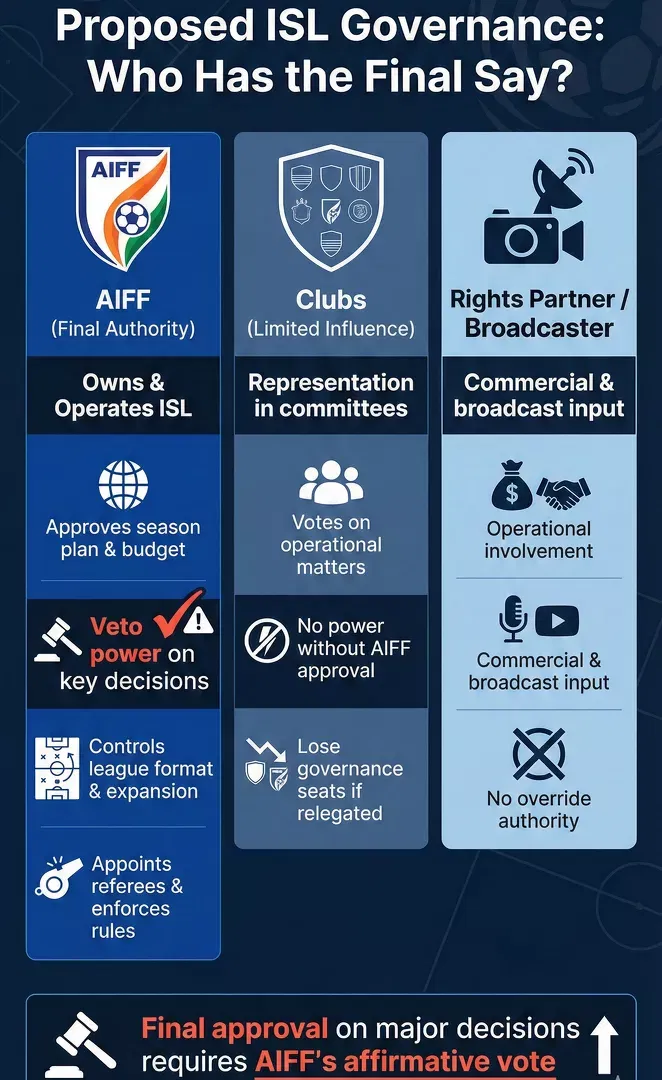
At its core, the proposal quietly but clearly shifts the ISL towards a federation-controlled model, where clubs and commercial partners are involved in the process, but the AIFF retains final authority and a decisive veto over all key decisions.
Catch Every Update, Anytime, Anywhere
What is AIFF proposing? (Big picture)
AIFF intends to:
- Own, organise, and operate the ISL directly
- Introduce a two-tier governance structure
- Separate day-to-day operations from top-level oversight
- Ensure AIFF has the final say on all major matters
The proposed system has two bodies:
- Governing Council – the top authority
- Management Committee – handles daily operations
1. Governing Council: The real centre of power
The Governing Council is the highest authority within this proposed ISL structure.
Who will be part of it?
- AIFF President / Secretary General,
- AIFF Vice President
- AIFF Treasurer
- One representative from each participating ISL club
- Three representatives of the Rights Partner / Broadcaster
- Two Independent Members (one nominated by AIFF, one by clubs)
All Independent Member appointments are subject to approval by the AIFF Ethics and Dispute Resolution Committee.
👉 The Chairperson of the Governing Council will always be the AIFF President or Vice President.
Role and responsibilities
The Governing Council will:
- Approve the ISL season plan and annual budget
- Supervise the functioning of the Management Committee
- Intervene in cases of governance failures, procurement issues, or non-compliance
- Ensure alignment with AIFF’s long-term football development objectives
- Hold the power to amend, modify, or repeal the governance charter itself
Voting rule that matters most
All decisions require a simple majority, with at least two affirmative votes from AIFF representatives. In practical terms, this means no major decision can pass without AIFF’s backing.
Independent Members are part of the structure, but they do not dilute AIFF’s voting power or override the mandatory AIFF affirmative vote requirement.
Even if everyone else agrees:
- At least two AIFF votes are compulsory
- No AIFF support = no decision
2. Management Committee: Running the league day to day
The Management Committee will handle the operational and commercial execution of the ISL.
Who will be part of it?
- AIFF Secretary General / Deputy SG (Chairperson)
- AIFF Head of Competitions
- AIFF Head of Strategy
- Five club representatives
- Three Rights Partner representatives
How clubs are represented
- One representative each from the top two clubs of the previous ISL season
- Three representatives elected by clubs through a simple majority vote
- Representation is rotated, with cooling-off periods to prevent dominance
Club representatives will automatically lose their seats on the Management Committee or Governing Council if their club is relegated from the ISL, directly linking on-field performance to governance presence.
How decisions will be taken (Very important)
Routine matters
Including:
- Match operations
- Marketing and fan engagement
- Vendor selection via tender
- Spending within the approved budget
➡️ These decisions will be taken by a simple majority vote.
High-value and strategic decisions
Including:
- Contracts exceeding ₹1 crore
- Long-term agreements beyond three years
- Broadcast or commercial rights matters
- Budget deviations beyond 10 per cent
➡️ These require a simple majority plus at least one affirmative AIFF vote.
Revenue sharing and major financial changes
Any decision related to:
- Revenue redistribution
- Prize money allocation
- Material alteration of the approved budget
➡️ Requires a 75 per cent super majority, with at least two AIFF affirmative votes.
In short, clubs will be consulted, but they will not be in charge.
Financial oversight and budget control
- The annual ISL budget must be approved at least three months before the season begins
- All spending must stay strictly within the approved framework
- Any major deviation requires formal approval
This creates a centralised and tightly regulated financial system, focused on control and compliance rather than commercial flexibility.
AIFF’s reserved powers (Non-Negotiable)
Regardless of the governance bodies, AIFF retains exclusive authority over:
- ISL format and competition structure
- Number of clubs
- Expansion or contraction of the league
- League rules and regulations
- Referees and match officials
- Discipline, integrity and anti-doping
- Laws of the Game
These powers are non-negotiable and cannot be overridden by clubs or commercial partners.
Appeals, ethics & oversight
- Members must declare conflicts of interest and recuse themselves where applicable
- All governance members are bound by the AIFF Code of Ethics
- Any stakeholder, including clubs, players, or commercial partners, may seek reconsideration of decisions
- Final authority rests with the AIFF Executive Committee, reinforcing federation supremacy
Meetings and governance process
- The Management Committee will meet at least once every month
- The Governing Council will meet at least once a year, preferably before the start of the ISL season
- Quorum rules mandate mandatory AIFF, club and Rights Partner presence, preventing decisions from being taken in isolation.
Pros of AIFF’s Proposed ISL Model
✅ Brings clarity and structure after prolonged uncertainty
✅ AIFF alignment with FIFA & AFC governance norms
✅ Prevents unchecked commercial control
✅ Strong regulatory and compliance oversight
✅ Rotational club representation reduces the concentration of power
Cons & concerns
❌ Heavy centralisation of power with AIFF
❌ Clubs have participation in both bodies, but limited decision-making power
❌ Revenue redistribution becomes difficult without federation backing
❌ Commercial flexibility is reduced, especially compared to earlier ISL seasons
❌ Risk of bureaucratic delays affecting league growth
❌ Independence on paper, but enforcement is still AIFF-driven
The bigger picture
This proposal reflects AIFF’s intent to prioritise stability and regulatory control over rapid commercial expansion.
For clubs, it offers certainty, but at the cost of influence, a trade-off that not everyone may be comfortable with.
Under this model, the ISL would function as a federation-led league with stakeholder participation, rather than a commercially driven competition with federation oversight.
It is important to reiterate that this governance framework is a proposal by AIFF and may still undergo changes before any final adoption. How effective it ultimately proves will depend less on the structure itself and more on how transparently and flexibly the system is implemented.
Is AIFF’s new ISL governance model final?
No. The framework shared with clubs is only a proposal at this stage. It may still undergo changes before being formally adopted.
Who will have the most power under the proposed ISL structure?
The All India Football Federation (AIFF) will hold final authority. While clubs and broadcasters are involved, all major decisions require AIFF’s approval.
How will clubs be represented in ISL decision-making?
Clubs will have representatives on both the Governing Council and the Management Committee. However, representation is rotational, and clubs cannot dominate decision-making.
What happens if a club is relegated from the ISL?
Under the proposal, club representatives will automatically lose their governance positions if their club is relegated, linking on-field performance with off-field influence.
For more updates, follow Khel Now on Facebook, Twitter, Instagram, Youtube; download the Khel Now Android App or IOS App and join our community on Whatsapp & Telegram.