
Merit over Millions: Blue Tigresses Roar Louder Than Wallets
As Blue Tigers stumble, Blue Tigresses hunt for laurels.
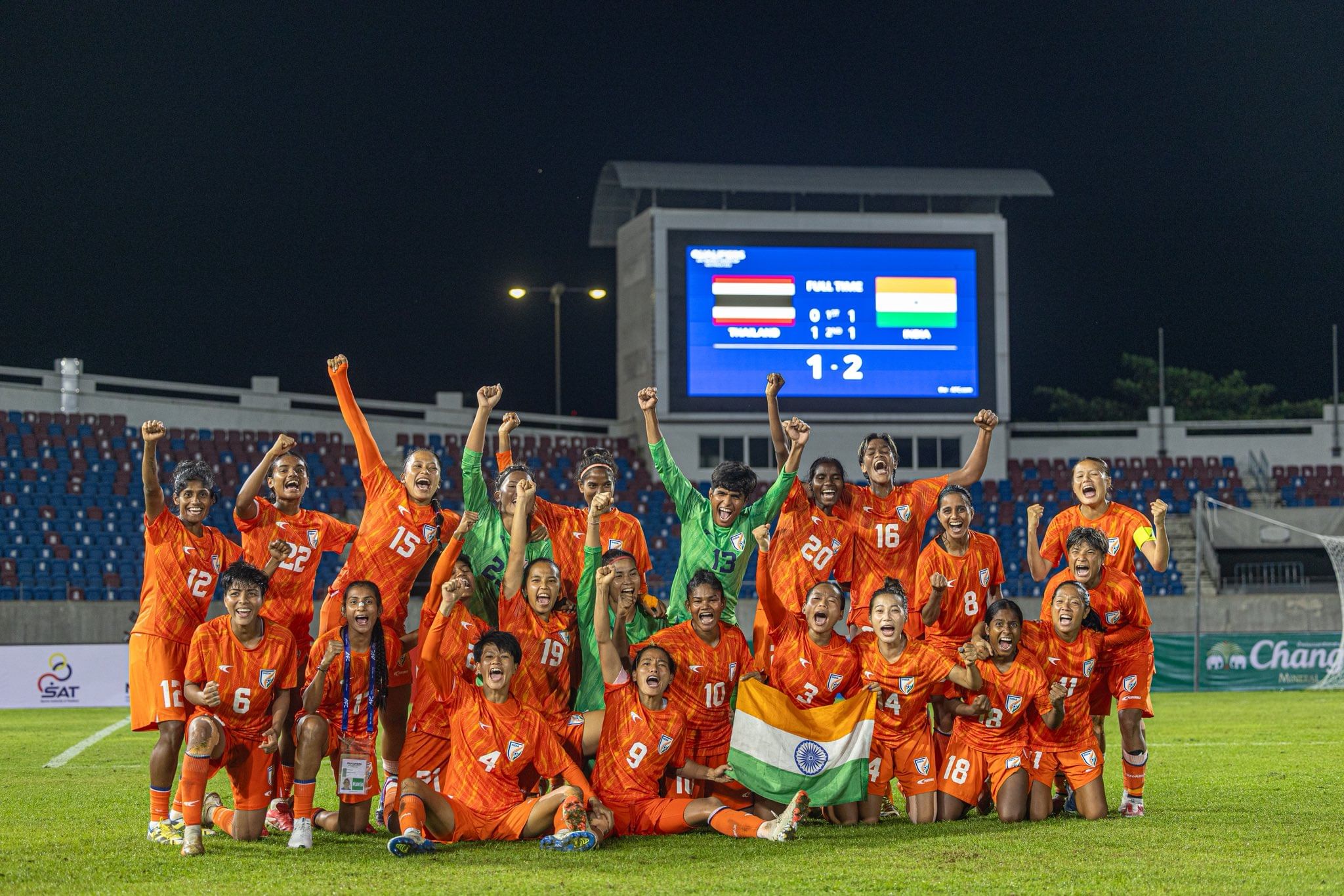
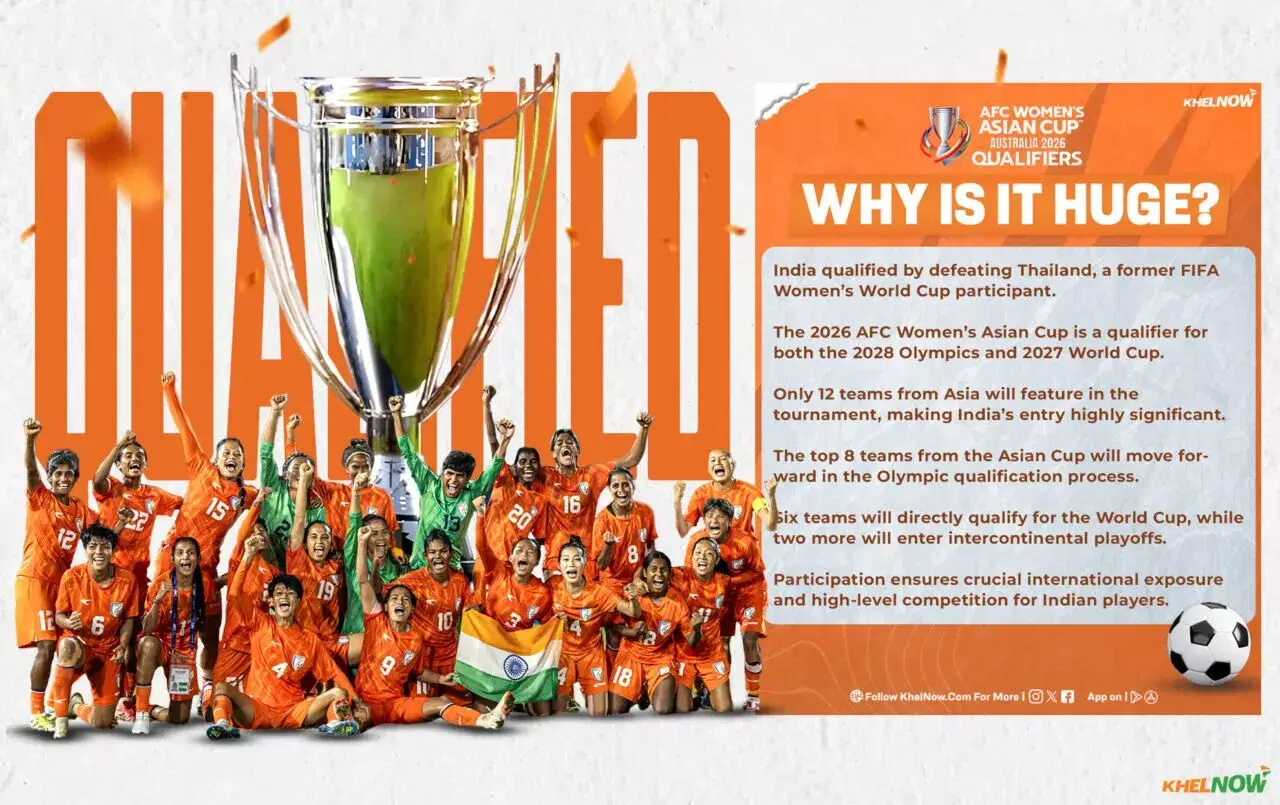
On the night of July 5, 2025, under the heavy lights of Chiang Mai Stadium, the Indian women’s football team rewrote history. With a hard-fought 2‑1 win over hosts Thailand, the Blue Tigresses sealed qualification for the 2026 AFC Women’s Asian Cup, their first-ever on merit. No favours, no shortcuts, no host pass. Just football. Just grit. Just belief.
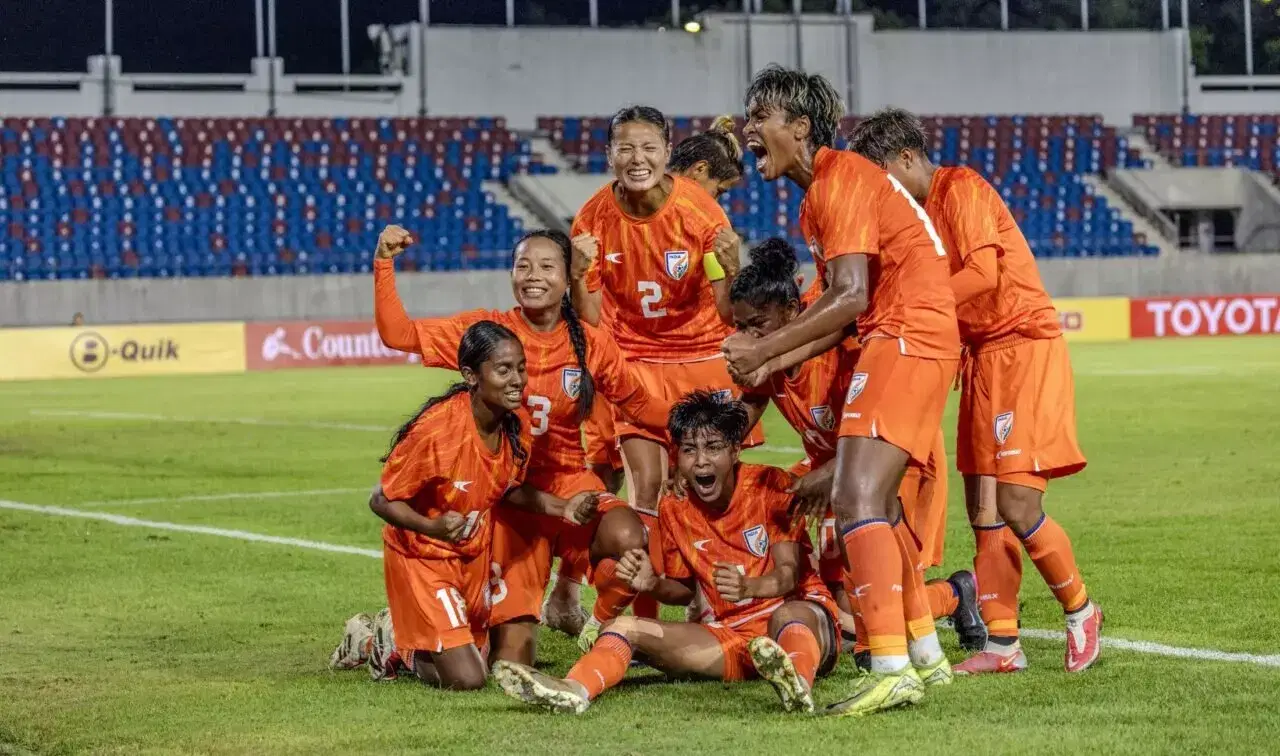
As Sangita Basfore fell to her knees in tears, the victory became more than just a result. It was a reckoning. A roaring statement from a team that has long been underfunded, undercovered, and underestimated yet continues to rise with every kick of the ball.
“They Make Their Own Luck”
Catch Every Update, Anytime, Anywhere
It wasn’t expected to happen, not in a foreign stadium. Not against a team ranked 24 places higher. Not from a team that came into the qualifiers on the back of four consecutive losses and a slip to the 70th rank. And definitely not by a squad that doesn’t even have a full-time coach.
And yet, there was Sangita Basfore fighting back tears after scoring twice on what she later called “the hardest night of my career, but my proudest moment.”
To understand the weight of her tears, you have to understand what these women endure week in and week out.
Her goals didn’t just win the match they flipped the script entirely. But the truth is, her performance wasn’t some miracle. It was the result of everything this team has quietly endured and worked for.
The Blue Tigresses didn’t just sneak into the AFC Women’s Asian Cup. They earned it, with conviction. A 13–0 thrashing of Mongolia. A commanding 5–0 win against Iraq. A confident 4–0 victory over Timor-Leste. There was no set starting XI. No overreliance on a few stars. Instead, 22 players were rotated throughout the campaign.
But behind those scorelines is a story of chaos, patchy support, and constant uncertainty.
Leading them was Crispin Chettri, who couldn’t even be on the touchline due to licensing issues but still managed the team from the sidelines with clarity and calm. In fact, India were the only team in the entire qualifying round that did not have their recognised coach on the bench. But that didn’t stop them.
But that night in Chiang Mai was about more than just one goal or one game it was a stand against everything the system had thrown at them. The results didn’t come from individual magic; they came from teamwork, belief, and a shared hunger to prove a point. Because back home, the road has never been smooth.
Weathering the Storm: From 3 PM matches to Coach Carousel
These women return to a domestic league that barely gives them room to grow, let alone dream. The infrastructure is sparse, the investment minimal, and the spotlight dim.
Players play in the scorching heat and travel on shoestring budgets. Most teams play just 14 to 16 games a year—too few to build match rhythm and far too little to build a league. For many players, this league doesn’t even feel like a career.
Meanwhile, in the national setup, these women have carved their path through campaigns that shuffled coaches faster than jerseys. Until this year, most of the women had never had a proper national camp.
Preparations were always rushed. Coaches changed so often, players barely had time to settle into a system. Facilities? Inconsistent at best. And yet, they kept showing up.
These players have battled not just opponents but an unforgiving domestic structure that offers them little support and even less recognition. Their success wasn’t handed to them, it was carved out of unyielding spirit, forged through weeks of discipline, cohesion, and belief.
So when Sangita scored and dropped to her knees, it wasn’t just about the win. It was everything behind it, the frustration, the doubt, the hours in camp, the years of being overlooked. It was the payoff of a journey that, for the longest time, didn’t even seem to be going anywhere.
And somehow, they still made it. On merit. On heart. ON THEIR OWN TERMS.
Men vs Women: Contrast in Support and Results
At the very moment the Blue Tigresses sealed a historic victory, the men’s team was struggling, no win in two Asian Cup qualifying matches: a sluggish draw with Bangladesh followed by a choppy loss to Hong Kong.
The contrast is glaring: one side, neglected and under-resourced, beats the odds; the other, lavished with attention and support, continues to underdeliver.
It begs a crucial question: why does success come from those least given a chance?
To put things in perspective, the men’s team were promised USD 50,000 for simply beating Hong Kong. Meanwhile, the women will receive the same amount for something truly monumental: securing a historic qualification that could take them to the World Cup.
One wonders if the AIFF believes that, for the men’s team, showing up and doing the bare minimum now counts as bonus-worthy. Or have things gone so far downhill that a single win for the men now feels as big as qualifying for a continental tournament for the women? Is that really how low the standard has fallen?
In its latest budget reveal, the AIFF has handed ₹4.76 crore to the men’s football team and a humble ₹2.74 crore to the women’s team including all youth squads.
And if that wasn’t telling enough, the federation has almost matched that amount for…
wait for it…
their Media & PR team (₹2 crore).
Because clearly, Instagram posts and press releases are just as crucial as funding players and developing the players. Why invest in athletes when you can just spin the narrative instead? Priorities, right?
When Sangita lifted her father’s memory and sacrifices into that historic win, her tears told many stories of pain, perseverance, and purpose. So too did the rehabilitation of players like Manisha Kalyan and Soumya Gugoloth, who ventured to Europe, Manisha even became the first Indian to find the net in the UEFA Champions League. Each milestone carried the weight of unseen struggle.
The Pay Disparity: A Chasm of Cricket-Sized Proportions
Salary inequity in Indian football isn’t news; it’s a wider national scandal. Pay disparity in Indian football isn’t just a talking point; it’s an epidemic.
In early 2023–24, AIFF rolled out big promises: a minimum IWL player wage of ₹3.2 lakh, U17 leagues, and a structural revamp—only to see those plans scrapped.
Clubs baulked at the minimum wage rule, citing weak revenue and infrastructure. Meanwhile, the federation trimmed women’s staff budgets and grassroots spending, only bolstering PR and administrative divisions instead. These moves confirmed what players already knew: talk may be loud, but actions are faint.
While women make do with peanuts, men’s football flaunts blockbuster deals. Blue Tigresses stars like Sweety Devi, Ashalata Devi, and Karthika reportedly make between ₹7–9 lakh per year, with the highest perhaps grazing ₹10–12 lakh. In contrast, male national teammates can command as much as ₹2 crore. Even the most basic players in ISL who might not even make it to the national team earn close to ₹40-70 Lakhs.
Let’s take for example, in a move that turned quite a few heads, Mohun Bagan Super Giants snapped 20-year-old Abhishek Tekcham up from Punjab FC for a ₹1.8 crore transfer fee, with a whopping ₹2.1 crore annual salary, tallying over ₹8.1 crore across a three-year contract.
Compare that to the women’s top earners barely hitting ₹10 lakh, and the gulf becomes jaw-dropping.
The IWL champions pocket ₹10 lakh, compared to ISL winners who receive ₹6 crore. These numbers are more than a stark difference, they’re a statement: the women outperform, yet remain underpaid by league-wide standards.
Now, of course, the most obvious excuse rolls in: “But the men’s game brings in more money!”
Sure, one of the most common defences for the pay gap is that the men’s game generates more revenue and yes, that’s currently true. But that’s exactly the point.
The disparity isn’t just in salaries; it begins with the intent, investment, and visibility. Indian women’s football hasn’t been given the same marketing push, broadcast priority, or structural support that fuels men’s revenue.
How do you expect the women’s game to grow when it’s barely allowed to breathe?
These players have done their part delivering results, qualifying for continental tournaments, and flying the flag despite minimal backing.
Now it’s time for broadcasters, sponsors, and stakeholders to step up. The women don’t just deserve equal pay they even deserve equal opportunity to generate it.
Give them the airtime, the platforms, and the promotional machinery, and the audience will follow. Because the demand is there, the talent is proven, and the time for excuses? It has long passed.
The Road Ahead: Can Dreams Be Given Wings?
The women’s team now eye AFC Women’s Asian Cup Australia 2026 and the 2027 World Cup—but only if the AIFF steps up with real support. Regular high-performance camps, better remuneration, quality friendlies, and logistical backing are all essential. Not token gestures! They need real, sustained investment.
Also Read: IWL preponed; 83-day camp for Indian women’s team before AFC Women’s Asian Cup 2026
Meanwhile, the men must justify their pay cheques with performance. Big-money signings like Tekcham are welcome—but only if talent development isn’t overshadowed by marquee gloss. Can the men match their contracts with results?
AIFF doing the ‘bare minimum’ as fans voice demands
Now that the Blue Tigresses have earned their spot and the federation has announced detailed plans including an 83-day camp and 10–12 international friendlies, there’s hope that the AIFF will revisit their budget, which was allocated before the historic qualification.
The early scheduling of the IWL and a clear prep roadmap show that the federation is finally paying attention to what fans have been demanding.
But intent alone won’t be enough. If AIFF truly wants to back its words with action, it must adjust the budget and give these women the support they’ve fought so hard to deserve.
Why does this story matter?
This isn’t just about football it’s about equality and fairness. The Blue Tigresses have shown that talent and spirit can shine even in the dimmest stadiums.
Their story is a mirror to the Indian football ecosystem: if the men’s game gave half the adversity to the women and half the investment to real potential, where could we be?
As the Blue Tigresses stride ahead, earning less but delivering more, it’s time India’s football powers stop talking and start investing. Not just in the hype, not just in media-friendly moves, but in equality, infrastructure, and belief.
Because when women succeed, sports and society win.
If India is serious about sporting excellence, the disparity must end.
As the men’s game trips over its privileges, the women are sprinting with purpose. The Blue Tigresses deserve nothing less than equal footing not for their sake, but for the future of Indian football.
How much did AIFF allocate for the women’s football team in their latest budget?
The AIFF allocated ₹2.74 crore for the women’s teams—including all age categories.
What is the average salary of top Indian women footballers?
Top Indian women footballers earn between ₹7–12 lakh annually, far below their male counterparts.
For more updates, follow Khel Now on Facebook, Twitter, Instagram, Youtube; download the Khel Now Android App or IOS App and join our community on Whatsapp & Telegram.