
Asian Games 2026: How Japan's preparations fell short & India's proactive response
Aichi-Nagoya is hosting the Asian Games 2026.
Japan built its Asian Games 2026 bid on a reputation for precision. Known for its bullet trains that run to the second, hospitality culture, and top-tier infrastructure, Japan’s reputation is exactly why the opening days of Aichi-Nagoya 2026 have been so jarring.
In the early days of the Games, several major logistical issues arose, such as athletes being forced to sleep in hotel lobbies, incorrect room allocations, and buses failing to arrive on time.
Such chaos can severely damage a country’s reputation as a host, but beyond the scattered reports, the public anger has reached a level we have never seen before.
The contrast is striking, particularly given the criticism India faced when it hosted the 2010 Commonwealth Games. The event faced widespread criticism for shortcomings in its organisation and infrastructure, with sections of the Indian media even branding it the “Shame Games” before international coverage amplified the criticism.
A collapsed footbridge, a falling ceiling panel, and reports of dirty athlete quarters became the defining images of that event, replayed for over a decade whenever India’s ability to host anything came into question. Compare that to what’s unfolding in Nagoya right now, and the gap in scrutiny is impossible to ignore.
Related: Asian Games 2026 – Reasons behind India women’s badminton team’s quarter-final exit
The scale of Japan’s failure is not small
Catch Every Update, Anytime, Anywhere
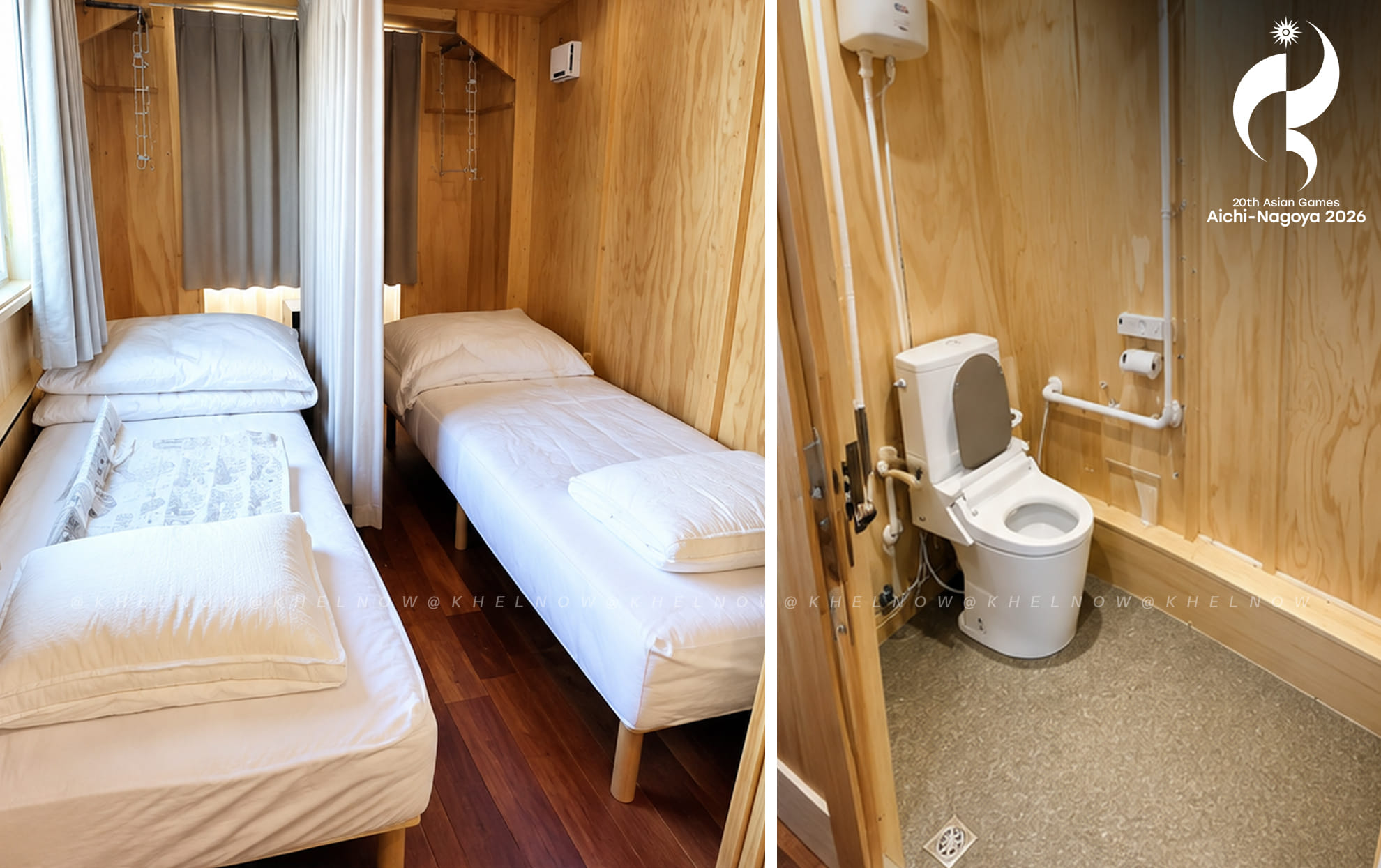
Strip away the polite framing organisers have used – “unexpected numbers,” “logistical mismatch,” and what’s left is a country that wasn’t ready. The decision to skip a conventional Athletes’ Village entirely, spreading over 11,000 athletes across hotels, shipping containers and a cruise ship, was a gamble from the start.
When the numbers rose from a planned 15,000 to nearly 17,000, that gamble collapsed in full view of everyone. Indian rowers waited more than 11 hours for rooms after reaching the Costa Serena. Three women rowers weren’t even in the registration system despite holding valid accreditation.
MMA fighter Varun Sanyal documented seven hours of waiting, only to be woken 30 minutes into his sleep by two more athletes assigned to the same room. Shooters found their booked hotel had given away rooms to dope control instead, while their coach’s accreditation didn’t even grant him access to the field of play.
A bus meant to carry the shooting delegation to the range filled up so fast that coaches and support staff were asked to step off to make room. A journalist reportedly spent over two hours just trying to get from Nagoya Station to the Main Press Centre, and an Indian coach summed up the mood in four words: “Everything is Ram Bharose (Everything is at god’s will).”
This wasn’t isolated to India, either. China’s world champion gymnast Zhang Boheng described waiting six hours in heavy rain, going without a proper meal from 7 AM until nearly 7 PM. South Korean basketball player Byeon Jun-hyeong posted footage of a leaking sink flooding his room, captioned simply, “Please help us.”
South Korean officials went so far as to describe the edition as the “worst-ever” Asian Games, citing the shortage of available accommodation and beds as a major concern.
Even Japan’s own athletes weren’t spared, as some were mistakenly assigned to shared rooms with the opposite gender and had to be moved to backup accommodation.
When the host nation’s own team gets caught in the same mess as everyone else, it stops being an isolated hiccup and starts looking like a structural failure.
Related: PV Sindhu’s schedule at Asian Games 2026 – Event date, live streaming, opponents & more
Where is the media and press outrage?
Here is the uncomfortable question nobody in the international press seems eager to ask. If India were the host, would the coverage of these issues be the same as it is now?
Had India been the host, would the coverage surrounding these issues have looked anything like it does now? Anyone who remembers 2010 already knows the answer.
Back then, a Commonwealth Games Federation official called parts of the athletes’ village “uninhabitable,” and it became a global story for weeks. Lalit Bhanot, the CWG organising committee’s general secretary, was mocked worldwide for suggesting that international cleanliness standards “differ” from local ones.
Fifteen years later, a fully developed G7 nation with decades of hosting experience and a global reputation for organisational excellence has produced problems that are unacceptable for a multi-sport event as prestigious as the Asian Games.
India’s proactive response has been the real story
What deserves genuine credit here is how India’s own management handled a crisis it didn’t create. Chef de Mission Sahdev Yadav activated a three-layer contingency system almost immediately.
Two representatives were stationed at the airport to assist arriving athletes, while three officials were deployed at the Athlete Welcome Centre to address accommodation issues on the spot.
In addition, a database of around 2,000 Indians living in Nagoya was identified as a potential emergency housing network should the shortage worsen.
Around 30 to 35 athletes were affected by the accommodation shortfall, and India responded by booking 18 additional hotel rooms, with plans for 10 more.
None of that was reactive scrambling born out of India’s own mismanagement. It was preparation for someone else’s failure.
The Sports Authority of India (SAI) had even constructed container-style mock rooms at its Bengaluru and Patiala training centres months in advance, allowing athletes to familiarise themselves with the unconventional accommodation model that Japan had announced ahead of the Games.
Japan still has time to right the ship, and organisers deserve some credit for scrambling to fix individual complaints as they arise. But the early days of Aichi-Nagoya have exposed something worth remembering the next time a developing nation gets cornered for its own hosting stumbles.
Which Japanese city is hosting Asian Games 2026?
Aichi-Nagoya is hosting the Asian Games 2026.
Where is the Indian contingent staying at Asian Games 2026?
After initial logistical delays and room shortages, the Indian contingent is staying in officially arranged temporary accommodations—including the Italian cruise liner Costa Serena, docked at the Port of Nagoya, and designated local hotels.
For more updates, follow Khel Now on Facebook, Twitter, and Instagram; download the Khel Now Android App or IOS App and join our community on Whatsapp & Telegram