
Explained: FIFA U-15 World Cup & Festival — Format, rules, qualification & what India can learn
FIFA’s newest youth competition will feature an 8v8 format, a festival-style structure and a greater focus on player development than results
FIFA is introducing a brand-new global tournament for youth footballers in 2026, but don’t expect it to resemble the U-17 or U-20 World Cups.
The FIFA U-15 World Cup and Festival has been designed with a different objective. Instead of putting winning above everything else, the competition aims to maximise touches on the ball, improve decision-making, expose young players to international football earlier and create a better pathway towards the FIFA U-17 World Cup.
For Indian football, the competition could be equally significant. It presents another opportunity for the AIFF to rethink how grassroots football is organised and whether the current pathway is preparing players well enough before they reach the national youth teams.
Here’s everything you need to know.
What is the FIFA U-15 World Cup and Festival?
Unlike FIFA’s traditional youth tournaments, the FIFA U-15 World Cup has been built around a festival model.
According to FIFA, the competition combines football with educational and cultural activities while placing individual player development at the centre. The governing body says the format has been specifically designed to increase player involvement, technical development and decision-making without compromising player welfare or competitive balance.
Rather than becoming another trophy-driven event, FIFA wants the tournament to serve as the first major international step in a player’s journey before progressing to the U-17 World Cup.
Why is FIFA introducing a U-15 World Cup?
The idea is simple.
Many talented players only experience international football when they are 16 or 17 years old. FIFA believes exposing them a couple of years earlier can improve long-term development.
The competition has five clear objectives:
- Improve individual and team development.
- Encourage creativity and technical quality.
- Strengthen talent identification.
- Prepare players for higher-level youth competitions.
- Promote innovation in youth football structures.
In short, FIFA wants more countries to identify talented youngsters earlier and give them meaningful international matches before they reach the U-17 level.
Why will matches be played in an 8v8 format?
Perhaps the biggest talking point is FIFA’s decision to move away from the traditional 11-a-side format.
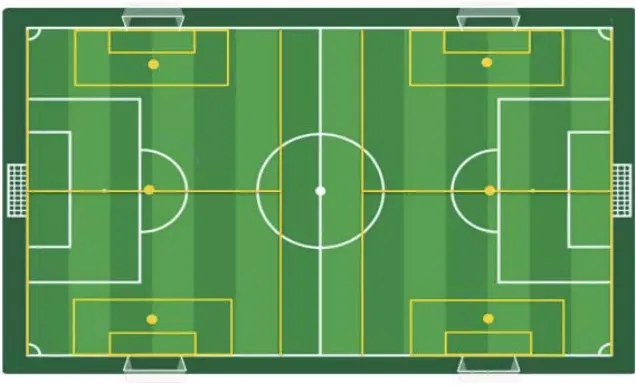
Every match will be played with eight players, including the goalkeeper, on a reduced-size pitch measuring 68m x 50m. Matches will consist of two 20-minute halves, with a five-minute half-time break.
The reason behind the change is straightforward.
With fewer players on the pitch, youngsters receive more touches, make more decisions, attack more often, and are involved throughout the game, rather than spending long periods without the ball. FIFA says extensive testing showed the format offers greater technical and attacking opportunities than traditional youth matches.
How does the tournament format work?
The inaugural FIFA U-15 World Cup and Festival will be held in Azerbaijan from October 22 to 31, 2026, with every FIFA Member Association invited to participate.
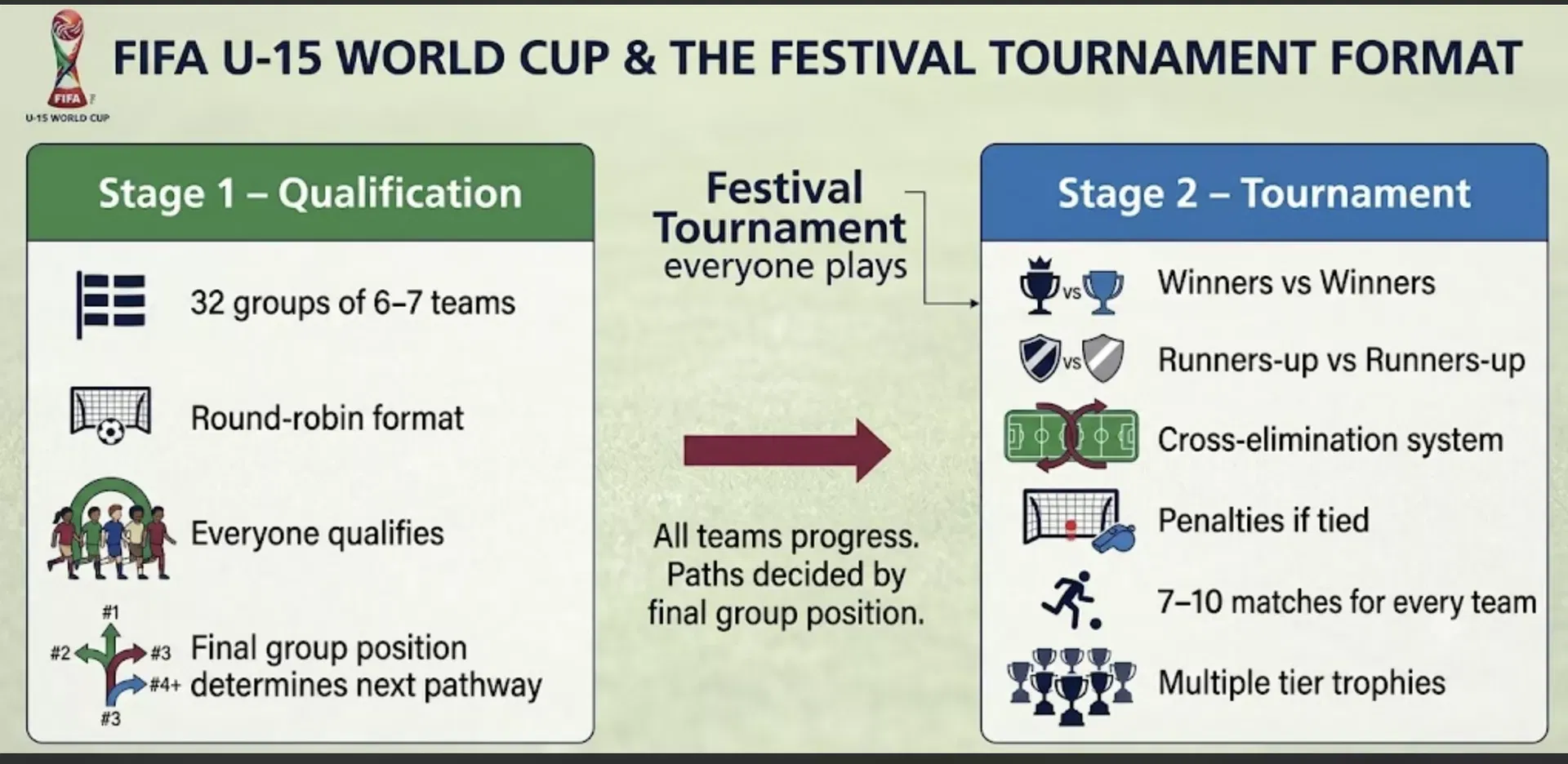
Unlike traditional FIFA competitions, the tournament has been split into two distinct stages, a qualification stage and a tournament stage, with every participating nation guaranteed multiple matches regardless of results.
Qualification stage
Catch Every Update, Anytime, Anywhere
The competition begins with a round-robin phase, where participating teams are divided into 32 groups of six or seven teams.
Each team plays every other team in its group once, with three points awarded for a win, one for a draw and none for a defeat. FIFA has also indicated that the number of groups and matches may change depending on the final number of participating teams.
However, unlike most tournaments, no team is eliminated after the group stage.
Instead, every team advances to the next phase. Their final position in the group determines which pathway they enter in the tournament stage. Group winners are placed together, runners-up are grouped together, third-placed teams form another tier, and so on.
Tournament stage
This is where the competition becomes different from a conventional knockout tournament.
Teams compete against opponents who finished in the same position during the qualification stage. For example, group winners play other group winners, while runners-up face runners-up.
Matches are played on a cross-elimination format, meaning winners continue to face other winners while losing teams are matched against teams that also lost in the previous round. There is no extra time—if a match ends level, the winner is decided by a penalty shootout.
The process continues until every team has completed its allotted fixtures. Importantly, no side is knocked out of the competition, ensuring every nation receives the same amount of playing time. Depending on the final number of participants, each team is expected to play between seven and ten matches across the tournament.
At the end of the tournament stage, teams are ranked based on their cumulative results, with separate trophies awarded across multiple tiers rather than just crowning one overall champion.
What are the main rules?
Some of the competition rules also differ from those of standard football.
- Teams can register 14 players, including at least two goalkeepers.
- Players must be born in 2011 or 2012.
- Unlimited rolling substitutions are allowed.
- Throw-ins are replaced by kick-ins.
- Offside applies only within the attacking third.
- Two referees officiate each match, each controlling one half of the pitch.
- Match duration: two halves of 20 minutes each
- Half-time interval: five minutes
All these changes are intended to keep the game flowing, encourage attacking football and maximise player involvement.
The field of play shall have the following dimensions:
- 68m x 50m
- Full‑size goals: 7.32m x 2.44m
- Full‑size penalty area including goal area
- Two offside lines positioned 23m from each goal line
How can India qualify?
FIFA has invited all Member Associations, including India, to participate in the inaugural edition.
AIFF have confirmed their participation in the tournament and also started the search for a new head coach for the India U-15 national football team.
What can AIFF learn from FIFA’s approach?
This tournament also offers several ideas that Indian football can adopt.
The biggest takeaway is the emphasis on development over results and trophies.
India currently pays significant attention to U-17 football, but introducing a structured U-15 national programme could help identify players earlier and better prepare them for continental competitions.
Another interesting aspect is the 8v8 format. FIFA believes that fewer players lead to more technical actions, quicker decision-making, and greater involvement for every youngster. While several European nations have already adopted small-sided football at younger age groups, India still largely follows traditional formats in many competitions.
The AIFF could also consider introducing more regional U-15 festivals rather than limiting youngsters to short domestic tournaments. More matches against different playing styles would naturally accelerate player development.
Finally, FIFA’s model recognises that youth football isn’t only about players. Teams are expected to travel with technical staff, medical personnel, a safeguarding officer and even a content creator, highlighting a more holistic approach to youth development.
Final thoughts
The FIFA U-15 World Cup is not simply another tournament added to an already crowded calendar.
Instead, it reflects a broader shift in youth football, where development, learning and match exposure take precedence over short-term results. For India, it is also a chance to reassess whether the current grassroots structure is producing enough players ready for international football.
If the AIFF chooses to borrow some of FIFA’s ideas, particularly small-sided football, earlier talent identification and increased match exposure, it could help strengthen the pathway from grassroots football to the national teams in the years ahead.
What is the FIFA U-15 World Cup and Festival?
The FIFA U-15 World Cup and Festival is a new global youth competition aimed at promoting early talent development. It combines competitive football with educational and cultural activities while serving as a stepping stone towards the FIFA U-17 World Cup.
Why will the FIFA U-15 World Cup be played in an 8v8 format?
FIFA has adopted the 8v8 format to give young players more touches on the ball, improve decision-making, encourage attacking football and maximise technical development.
How does the FIFA U-15 World Cup format work?
The tournament has two stages. Teams first compete in a round-robin qualification stage before progressing to a tournament stage, where they continue playing teams of similar rankings. Every team is guaranteed multiple matches regardless of results.
How many matches will each team play?
Depending on the final number of participating nations, each team is expected to play between seven and ten matches during the competition.
Who can participate in the FIFA U-15 World Cup?
The competition is open to players born in 2011 or 2012 for the inaugural edition. Every participating team can register 14 players, including at least two goalkeepers.
What can the AIFF learn from FIFA’s U-15 model?
The AIFF could consider introducing more small-sided football, expanding U-15 competitions, increasing the number of competitive matches for young players and creating a structured development pathway before the U-17 level.
For more updates, follow Khel Now on Facebook, Twitter, Instagram, Youtube; download the Khel Now Android App or IOS App and join our community on Whatsapp & Telegram.