
AIFF's regular accounts show ₹11.25 crore in March, India vs Brazil bill runs to ₹70 crore
Federation cites the confidentiality clause on the Brazil contract but confirms no bonds or fixed deposits have been broken.
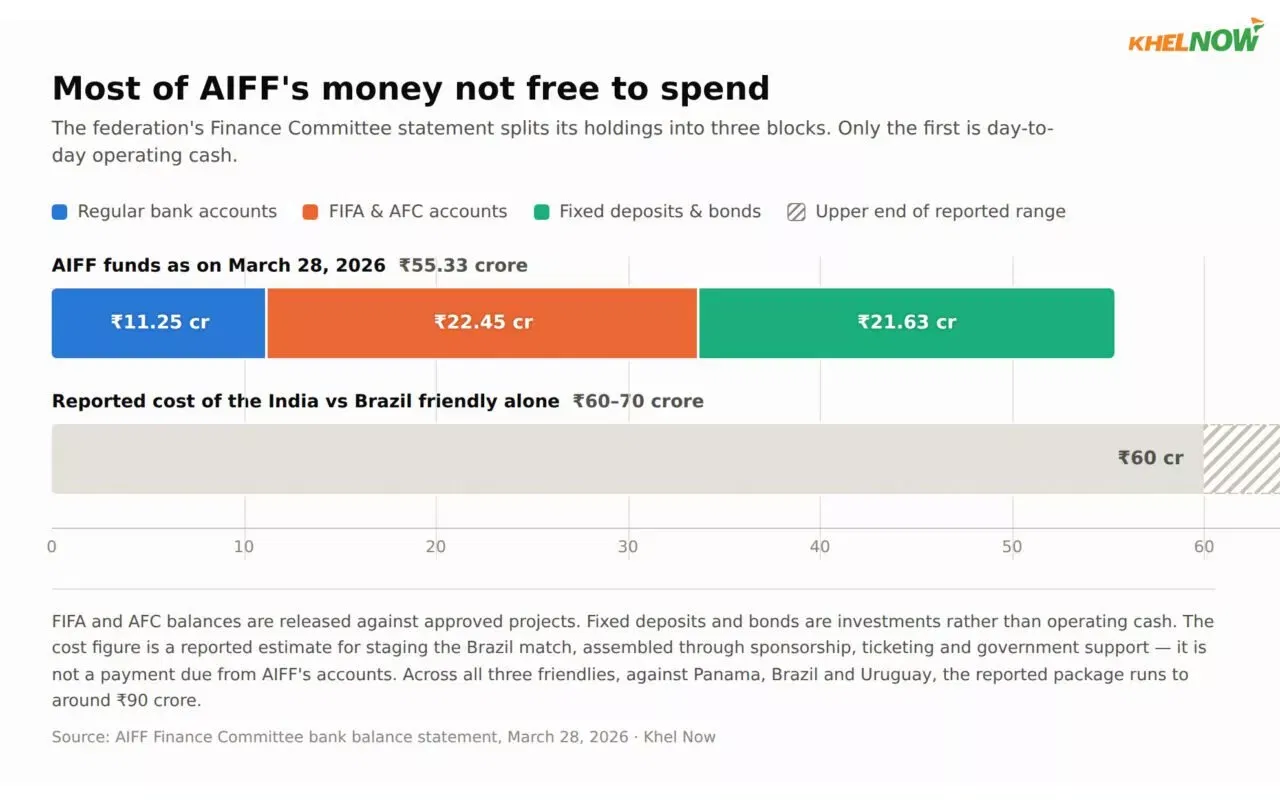
The All India Football Federation (AIFF) had ₹11.25 crore in its regular savings bank accounts as on March 28, 2026, Khel Now has learnt.
The figure appears in a bank balance statement prepared for the federation’s Finance Committee, accessed by Khel Now. The statement splits AIFF’s holdings into three separate blocks.
Apart from the regular accounts, it shows ₹22.45 crore in accounts the federation itself marks as FIFA and AFC accounts* and another ₹21.63 crore in fixed deposits and bonds.
*Money received from FIFA and AFC can only be released against approved projects and comes with conditions on how it is spent and reported.
Together, the three blocks come to ₹55.33 crore.
The timing makes the numbers relevant. India will host three FIFA World Cup nations in international friendlies. The Blue Tigers take on Panama on September 26, Brazil on October 3 and Uruguay on October 6.
According to various media reports, the federation has been putting together a package worth approximately ₹90 crore for the three fixtures through sponsorships, ticket sales, and government support. Between ₹60 crore and ₹70 crore of that is for the Brazil match alone.
It is the largest financial commitment AIFF has taken on since its guaranteed rights income from the ISL ended in December.
Khel Now put a detailed set of questions to the federation on its financial position and the funding of the fixture. However, most of them went unanswered.
What the statement establishes
The split between the three blocks matters when reading the document.
The money AIFF had immediately available in its operating accounts on March 28 was ₹11.25 crore. The FIFA and AFC balances are tied to specific programmes. Deposits and bonds can be liquidated, but they are not day-to-day cash.
Even the combined ₹55.33 crore sits below the reported cost of the Brazil fixture alone.
That does not establish that the federation cannot fund the match. The documents do not show how the Brazil project is being financed, what share the West Bengal government is carrying, or how much is expected back through sponsorship, broadcast and ticketing.
What AIFF said
Khel Now sent the federation a set of questions covering its current financial position, the approved budget for the Brazil fixture, the fee payable to the Brazilian confederation, the funding split, and whether any of AIFF’s own money had gone towards the match.
Most were not answered.
“Most of your questions cannot be answered, as the Brazil contract has a confidentiality clause,” an AIFF official told Khel Now.
“No bonds or fixed deposits broken. None.”
Khel Now is still awaiting a response to the remaining questions.
That answer settles one thing. On the federation’s own account, the ₹21.63 crore held in fixed deposits and bonds has not been touched for the fixture.
It leaves the larger question open. AIFF did not say whether money from the regular bank accounts, or from the FIFA and AFC accounts, has gone towards the Brazil project in any form, including as a temporary advance. It gave no figure for the total budget, no figure for the CBF fee, and no breakdown of what the West Bengal government, sponsors and broadcasters are carrying.
Khel Now also asked what the federation’s accounts hold today. It did not provide the figure.
The confidentiality clause is itself worth noting.
A fixture being staged at a state-owned stadium with government support is one whose terms the federation says it cannot disclose.
Why the March position may have changed
The statement is close to five months old, and the year behind it leaned heavily on rights sales.
AIFF’s figures up to February 28 showed ₹93.67 crore in income against ₹85.47 crore in expenditure, leaving a surplus of ₹8.20 crore.
Of that income, ₹36.88 crore came from “Sale of Master Right” and another ₹2.16 crore from “Sale of Right – ISL” — close to 42% of everything booked. The Master Rights figure covers only part of the year, with the agreement running until December 2025.
Football Sports Development Limited’s (FSDL) Master Rights Agreement with the AIFF, a 15-year deal worth ₹700 crore, expired on December 8, 2025, and was not renewed. The ISL has since moved to a club-led model from the 2026-27 season.
In place of that rights income, the federation is set to receive ₹14.3 crore in participation fees from the 13 ISL clubs, at ₹1.10 crore per club.
Why did India skip the ASEAN Cup?
Catch Every Update, Anytime, Anywhere
India have withdrawn from the FIFA ASEAN Cup 2026 because of the scheduling conflict with the Brazil friendly, with FIFA declining to let the country field a U-23 or B team.
That tournament would have brought money in rather than sent it out. AIFF would have received a participation payment from FIFA, along with free travel and logistics for players, coaching staff and officials.
The federation went with Brazil instead.
The most recent picture on record
The March statement remains the most recent full picture of AIFF’s banking position. The federation’s audited report for the 2025-26 financial year is likely to be published later this year.
It shows a federation with the bulk of its money either earmarked against FIFA and AFC programmes or locked into deposits and bonds, and ₹11.25 crore in the accounts it runs its operations on.
That position has barely moved in three years. AIFF’s own audited accounts put ₹12.00 crore in its savings accounts on March 31, 2023, the end of Kalyan Chaubey’s first full financial year as president.
A year-end balance is what remains after a full year of spending, and a figure that size is not alarming on its own. What matters is what was due to arrive next.
In 2023, that was settled. The Master Rights Agreement with FSDL guaranteed AIFF an annual payment, worth close to ₹50 crore a year in its later stages, and it was contracted to keep coming.
That agreement has ended. The March 2026 balance sits at the start of a financial year with no comparable guaranteed income behind it.
Two tenders, one bidder each
What replaced the MRA is a club-led league that has yet to name a broadcaster. The ISL’s media rights tender for the next four-season cycle drew one bid.
The Indian Women’s League commercial rights tender also drew one bid, from Capri Sports.
Khel Now understands no contract has been signed between the federation and Capri Sports, and no start date has been announced for the IWL. No schedule has been announced for the AIFF youth leagues for the coming season either.
One fixture carrying the weight
Against that record, Brazil reads less like an opportunity than a wager.
AIFF has skipped a tournament that would have paid it to turn up, taken on a fixture costing ₹60-70 crore to stage, and declined to say how it is being funded.
Chaubey’s tenure as president runs until the end of 2026, after the Sports Ministry deferred National Sports Federation elections to December 31, 2026. No election schedule has been announced.
If the package holds, the federation will have staged the biggest match played in India in years and covered its cost. It would be the strongest single result of his time in the chair.
If it does not, the loss lands on a body whose operating accounts held ₹11.25 crore in March, whose guaranteed rights income has ended, whose league has no broadcaster, whose women’s league has no signed commercial partner and no start date, and whose youth competitions have no calendar. No reserve sits behind it to absorb a bad night.
That is the part that reaches past the federation’s own books. A shortfall would not be a line item to be written off. It would set the ceiling on what Indian football can afford to do for years, and the programmes with no money behind them already are the ones that would feel it first.
Either way, a single friendly is now carrying more of Indian football’s finances than a friendly should. And on the federation’s own answer, the terms won’t be made public.
How much money did AIFF have in the bank?
AIFF had ₹11.25 crore in its regular bank accounts as on March 28, 2026, along with ₹22.45 crore in FIFA and AFC accounts and ₹21.63 crore in fixed deposits and bonds. The three blocks total ₹55.33 crore.
What did AIFF say about the Brazil match funding?
The federation told Khel Now that it could not answer most questions because the Brazil contract carries a confidentiality clause. It confirmed that no bonds or fixed deposits have been broken. Khel Now is awaiting responses to the remaining questions.
Has AIFF broken any fixed deposits or bonds for the Brazil match?
No. An AIFF official told Khel Now: “No bonds or fixed deposits broken. None.”
Which account held the most money?
An IDFC First Bank account marked FIFA Forward, with ₹20.26 crore. It was the single largest balance on the statement.
How much is the India-Brazil friendly expected to cost?
AIFF has been assembling a package worth approximately ₹60-70 crore for the October 3 fixture through sponsorships, ticket sales and government support.
Does this mean AIFF cannot pay for the Brazil match?
No. The documents show only what the federation held in its accounts on March 28. They do not show how the fixture is being financed or what share is being carried by the West Bengal government, sponsors and broadcasters.
Why did India withdraw from the FIFA ASEAN Cup 2026?
The tournament clashed with the Brazil friendly on October 3 and FIFA did not permit India to enter a U-23 or B team. AIFF would have received a participation payment from FIFA and free travel and logistics for the squad and staff.
How much will AIFF earn from ISL participation fees?
₹14.3 crore from the 13 ISL clubs, at ₹1.10 crore per club, paid in two instalments of ₹55 lakh.
What happened to the AIFF-FSDL Master Rights Agreement?
The 15-year deal worth ₹700 crore expired on December 8, 2025 and was not renewed. The ISL has moved to a club-led model from 2026-27.
For more updates, follow Khel Now on Facebook, Twitter, Instagram, Youtube; download the Khel Now Android App or IOS App and join our community on Whatsapp & Telegram.