
Explained: AIFF’s proposed I-League participation framework, very different from the ISL approach
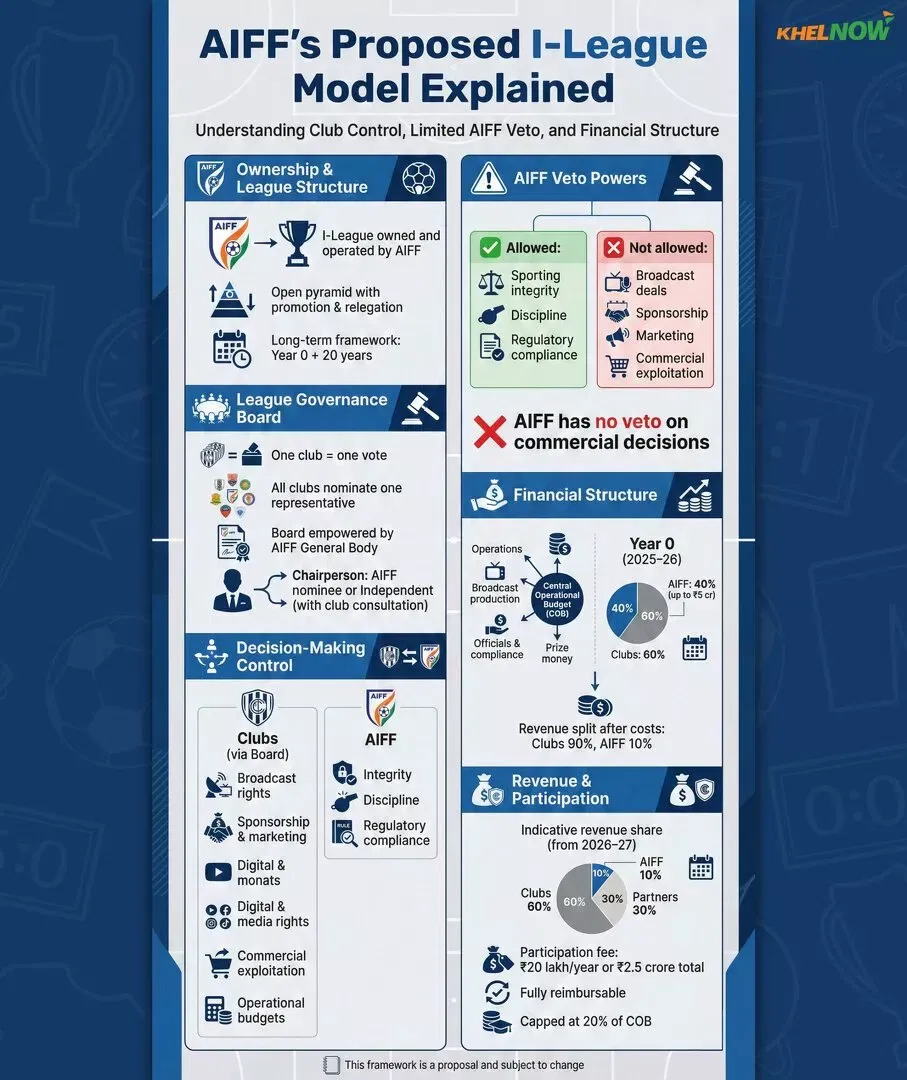
A simple breakdown of how AIFF plans to run, fund, and commercialise the I-League under a club-led governance model.
The All India Football Federation (AIFF) has shared a proposed participation framework for the I-League, outlining how the country’s second-tier men’s league could be governed, funded, and commercialised going forward.
Like the ISL governance model, this framework is not final and remains non-binding, but it offers rare clarity on AIFF’s thinking around the future of the I-League, particularly its governance philosophy, financial structure, and the role clubs will play.
At its core, the proposal positions the I-League as a club-driven competition operating under the AIFF’s regulatory umbrella but with significantly greater commercial and operational autonomy than the ISL.
Catch Every Update, Anytime, Anywhere
Big picture: What is AIFF proposing for the I-League?
Under the proposed framework:
- The I-League will remain 100% owned and operated by AIFF
- The league will continue to function as an open pyramid with promotion and relegation
- A new League Governance Board will be created
- Clubs will collectively control commercial and operational decisions
- AIFF’s veto powers will be strictly limited
The agreement is proposed for Year 0 (2025–26 season) plus a 20-year term starting 2026–27, signalling long-term intent.
League Governance Board – Clubs at the Centre
Who will be part of it?
- Every participating I-League club nominates one representative
- Each club gets one vote
- The Board will be empowered by the AIFF General Body
- The Chairperson will be:
- An AIFF office-bearer (President / VP / SG), or
- An Independent Member appointed by AIFF in consultation with clubs
- An AIFF office-bearer (President / VP / SG), or
What powers does the Board have?
The League Governance Board will enjoy operational autonomy over:
- Broadcast rights
- Digital & media rights
- Sponsorship deals
- Marketing & branding
- Commercial exploitation of the league
- Operational budgets and financial planning
All of this is subject to AIFF statutes but not subject to routine AIFF approvals.
AIFF’s role and veto powers (clearly limited)
This is the most important part of the framework.
AIFF may exercise veto rights only on matters related to:
- Sporting integrity
- Regulatory compliance
- Disciplinary jurisdiction
Crucially, the framework explicitly states that AIFF will NOT exercise veto, approval, or intervention rights in:
- Broadcast rights
- Digital or media rights
- Sponsorship arrangements
- Marketing and branding
- Commercial exploitation of the league
This marks a clear separation between regulation and commercial control.
Commercial rights & Master Rights Agreement (MRA)
- The League Governance Board will have the exclusive right to negotiate and sign a Master Rights Agreement (MRA)
- The MRA will cover:
- Broadcast
- Digital
- Sponsorship
- Commercial exploitation
- Broadcast
- Commercial terms will be finalised later by the Board
- AIFF oversight exists, but not approval control
In effect, clubs collectively control the league’s commercial destiny.
Central Operational Budget (COB)
The I-League will operate on a central cost-recovery model, covering:
- League operations
- Broadcast production
- Marketing & digital
- Prize money
- Match officials
- Integrity, anti-doping & legal compliance
The COB will be approved by the Board and recovered before any revenue distribution.
Year 0 (2025–26): Special financial arrangement
For the upcoming season:
- AIFF will underwrite 40% of league expenses, capped at ₹5 crore
- Clubs will underwrite the remaining 60%
- After expenses:
- 90% of revenue goes to clubs
- 10% to AIFF
- 90% of revenue goes to clubs
This is designed as a stabilisation season, not a profit-first model.
Revenue sharing & participation fees
From 2026–27 onwards (Indicative):
- Clubs: 60%
- AIFF: 10%
- Commercial / equity partners: 30%
Participation Fee
- ₹20 lakh per club per year or ₹2.5 crore cumulatively
- Fully reimbursable from central revenue
- Capped at 20% of the COB
Compliance & regulation
AIFF retains responsibility for:
- Match officials
- Integrity & anti-doping
- Regulatory compliance
Clubs must comply with:
- Licensing norms (Premier 2 or future criteria)
- Competition regulations
Important legal note
This framework is non-binding, except for confidentiality and good-faith negotiations. Binding obligations will arise only after:
- Participation Agreements
- League Regulations
- MRA
- Financial & Governance Charters
How does this differ from the ISL model?
Related- Explained: AIFF’s proposed ISL Governance Model – What changes, who holds power & why it matters
While this participation framework is focused solely on the I-League, it is worth noting that AIFF’s proposed approach here is very different from the governance model it has outlined for the Indian Super League.
Unlike the ISL, where AIFF retains broad veto powers and final authority over most key decisions, the I-League proposal places clubs at the centre of commercial and operational control, with the federation’s role limited largely to regulation, integrity, and compliance.
The contrast highlights two distinct governance philosophies being considered by AIFF for its two men’s leagues. We have covered the proposed ISL governance framework separately, in which decision-making remains far more centralised within the federation.
Together, the two documents raise important questions about how AIFF views control, risk, and autonomy across different levels of Indian football, questions that are likely to shape discussions with clubs in the coming weeks.
Is AIFF’s I-League participation framework final?
No. The framework shared by AIFF is only a proposal and is non-binding at this stage. Final obligations will arise only after definitive agreements are signed.
Who will control the I-League under the proposed model?
While the I-League will remain owned by AIFF, clubs will collectively control commercial and operational decisionsthrough a League Governance Board.
What veto powers does AIFF retain in the I-League?
AIFF’s veto powers are strictly limited to matters related to sporting integrity, disciplinary jurisdiction, and regulatory compliance.
Who controls broadcast and sponsorship rights in the I-League?
Under the proposal, the League Governance Board will have the exclusive right to negotiate and sign broadcast, digital, and sponsorship agreements through a Master Rights Agreement.
How will the I-League be funded in the 2025–26 season?
For the 2025–26 season, AIFF will underwrite 40% of league expenses (up to ₹5 crore), while clubs will cover the remaining 60%, with revenues distributed after costs are recovered.
For more updates, follow Khel Now on Facebook, Twitter, Instagram, Youtube; download the Khel Now Android App or IOS App and join our community on Whatsapp & Telegram.