
Explained: What changed in the updated ISL Governance Charter?
Following stakeholder feedback, AIFF has revised its proposed ISL governance charter. Here’s a clear breakdown of what has changed, what hasn’t, and how power is now structured.
After sharing a proposed governance charter for the Indian Super League (ISL) earlier this month, the All India Football Federation (AIFF) has now circulated an updated version of the charter to participating clubs, based on feedback received from them.
While the core structure remains intact, the revised document introduces important clarifications, tighter definitions, and subtle recalibration of authority, particularly around finances, voting, and operational processes.
Previous model: Explained: AIFF’s proposed ISL Governance Model – What changes, who holds power & why it matters
Here’s a clear look at what has changed and why it matters.
📊 SIDE-BY-SIDE COMPARISON TABLE
Old vs updated ISL Governance Charter
| Aspect | Earlier Draft | Updated Charter |
|---|---|---|
| Budget Structure | Single central budget | Split into Restricted & Unrestricted |
| AIFF Affirmative Vote | Broad, loosely defined | Targeted to integrity & restricted funds |
| Revenue Redistribution | 75% + strong AIFF control | 75% + at least 1 AIFF vote |
| Secretary General | Role unclear | Explicitly non-voting |
| Governing Council Meetings | Limited clarity | Minimum 4 per year |
| Quorum Rules | Broad | Clearly defined numbers |
| Rights Partner Role | Loosely defined | Strictly limited |
| Operational Decisions | Voting heavy | Pre-approved routine matters |
| Emergency Meetings | Not explicit | Codified |
1. The central budget for ISL is now clearly ring-fenced
One of the most notable updates is the formal split of the central operational budget into two categories:
- Unrestricted Funds (up to 70%) Covering broadcast production, marketing, digital operations, prize money, and commercial activities.
- Restricted Funds (minimum 30%) Covering referees, central administration, youth competitions, integrity, anti-doping, legal matters, and parachute payments.
Why this matters
This ring-fencing ensures that regulatory and integrity-related spending cannot be diluted, even if commercial pressures rise during the season.
2. AIFF’s affirmative vote is narrower but still decisive
In the earlier version, AIFF’s affirmative vote was required broadly on “key matters.”
The updated charter narrows this language, linking AIFF’s mandatory approval specifically to:
- Allocation and changes involving Restricted Funds
- Integrity, disciplinary, and regulatory matters
- Budget deviations affecting protected categories
Why this matters
The change improves optics by avoiding blanket veto language, while still ensuring AIFF controls the most sensitive decision areas for ISL.
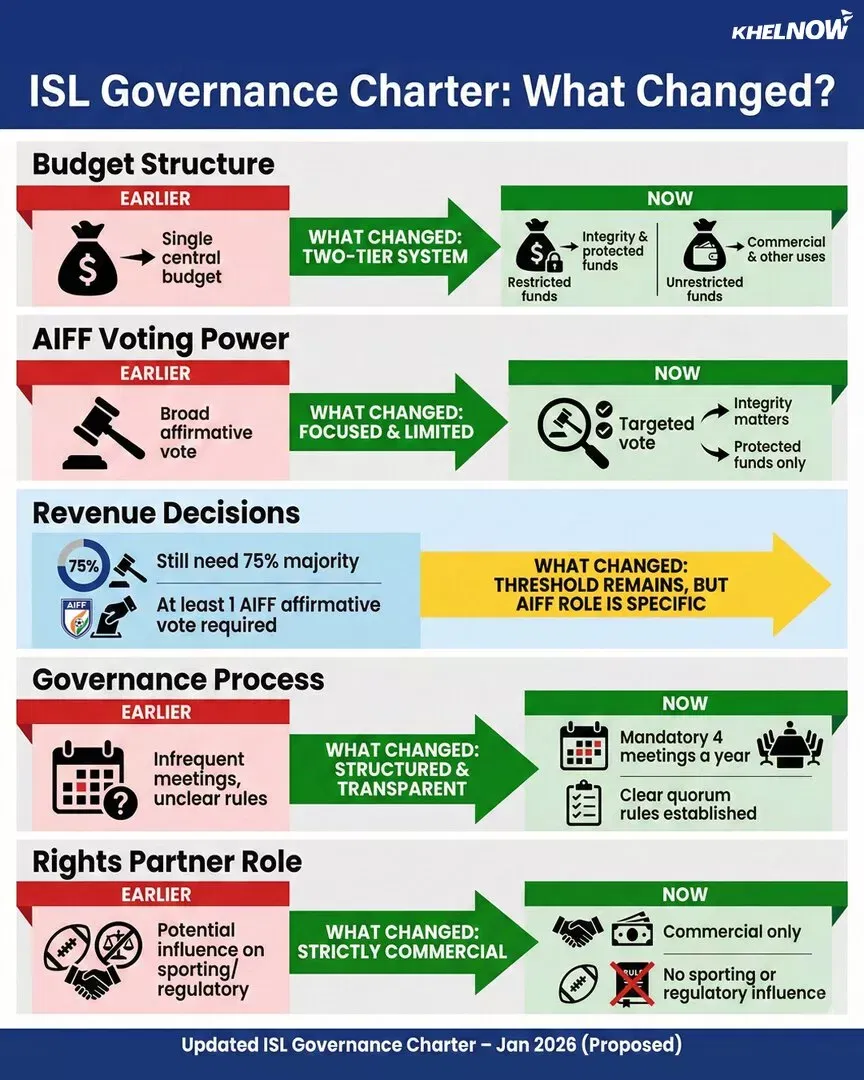
3. Revenue redistribution rules have been softened slightly
Under the updated charter:
- Revenue redistribution still requires a 75% super-majority
- But now needs at least one AIFF affirmative vote, instead of the stronger implied control earlier
Why this matters
This is a measured softening, signalling responsiveness to club concerns, while ensuring AIFF retains a blocking seat.
4. The Secretary General’s role is clearly defined as non-voting
The updated ISL charter explicitly states that the AIFF Secretary General serves on the Governing Council as a non-voting, ex officio member.
Why this matters
This removes ambiguity and slightly reduces concerns about over-concentration of voting power, even though AIFF still retains multiple voting members.
5. Governing Council meetings are now mandatory and time-bound
The revised document introduces strict meeting requirements:
- At least four Governing Council meetings per year
- No gap of more than three months
- Mandatory meetings:
- Three months before the season
- One month after the season ends
Why this matters
This directly addresses criticisms of inaction in governance and ensures continuous oversight.
6. Quorum requirements are now explicit
The updated charter clearly defines quorum:
- Governing Council
- Minimum 2 AIFF members
- At least 7 club representatives (or half, whichever is higher)
- 1 Independent Member
- Management Committee
- 2 AIFF members
- 2 club representatives
- 1 Rights Partner representative
Why this matters
No single stakeholder group can make decisions in isolation, closing potential loopholes.
7. Rights partner voting is narrowly restricted
The revised ISL charter limits the Rights Partner’s voting rights strictly to:
- Scheduling
- Broadcast and production matters
- Commercial inventory and advertising
- Sponsor integrations
They are explicitly excluded from:
- Regulatory decisions
- Sporting matters
- Disciplinary issues
Why this matters
This prevents commercial partners from influencing sporting governance.
8. Operational flexibility via “Pre-approved matters”
The Management Committee can now pre-approve routine operational items to avoid repeated voting.
However:
- Senior appointments, including a League Commissioner, require a 75% super-majority
Why this matters
AIFF introduces efficiency without loosening control over the key leadership role.
9. Emergency meetings and appeals are codified
The updated charter allows:
- Any two members can call an emergency meeting if the Chairperson fails to do so
- Defined timelines for reconsideration and appeals
Final authority continues to rest with the AIFF Executive Committee.
What has not changed
- Two-tier structure (Governing Council + Management Committee)
- AIFF ownership of the ISL
- Club representation framework
- Loss of governance seat upon relegation
- AIFF’s exclusive control over referees, discipline, and Laws of the Game
The bigger picture
The updated charter reflects a course correction rather than a power shift.
AIFF has refined language, improved clarity, and softened some thresholds, but the overall framework of ISL remains federation-led, with clubs involved but not in control.
How this structure functions in practice will now depend less on the document itself and more on how flexibly – or rigidly – it is implemented.
Is the updated ISL governance charter final?
No. The revised charter shared by AIFF is still a proposed document and not legally binding yet. It may undergo further changes before final adoption.
What is the biggest change in the updated charter?
The most significant update is the ring-fencing of the central budget into Restricted and Unrestricted funds, ensuring that integrity, regulatory, and referee-related spending is protected.
Has AIFF reduced its veto power in the new version?
AIFF has narrowed the scope of its affirmative vote requirements, but it continues to retain decisive authority over key areas such as integrity, compliance, and protected budget heads.
Can clubs now decide revenue sharing on their own?
No. Revenue redistribution still requires a 75% super-majority and at least one affirmative AIFF vote, meaning clubs cannot make such decisions unilaterally.
What remains unchanged despite the update?
The two-tier governance structure, AIFF’s ownership of the ISL, club representation rules, and AIFF’s exclusive control over referees, discipline, and the Laws of the Game remain unchanged.
For more updates, follow Khel Now on Facebook, Twitter, Instagram, Youtube; download the Khel Now Android App or IOS App and join our community on Whatsapp & Telegram.
Ashish Negi is the co-founder and CEO of Khel Now. A computer engineering graduate from LPU (2015), he has been closely following and covering Indian football and sports since 2007. He started the Indian Football Team Facebook page in 2013 and later handed it over to the AIFF in 2015 when it had grown to over 500K followers. Ashish continues to drive Khel Now’s vision while staying deeply connected to the pulse of Indian sport.