
Ontario and Alberta now have regulated online casino markets: How do the two provinces compare?
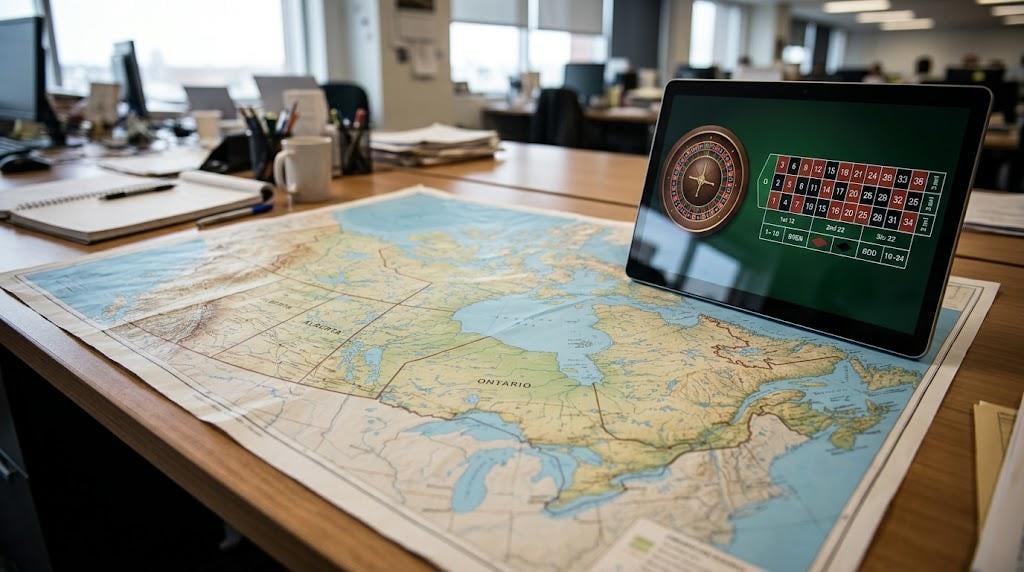
From operator licensing and revenue sharing to game variety and player protection, here’s how the provinces compare.
Catch Every Update, Anytime, Anywhere
Alberta made history on July 13, 2026, becoming the second province in Canada to legally offer online casino services through private operators. This was also the first time that Alberta opened digital gambling services to the private sector.
Since its launch, Alberta has become the second province, after Ontario, to offer regulated online casinos. With separate online casino markets, Players now have access to regulated private online casino markets in two Canadian provinces. Four years apart, two separate provinces launched online casino markets and each took a unique approach to designing their market.
Because it was the first Canadian province to offer a regulated private online casino market, statistics from Ontario paint a clearer picture. In 2025, licensed private operators generated over $5.5 billion CAD in gross gaming revenue. That figure represents a 34% increase from 2024.
By early 2026, 48 licensed private operators ran 83 gaming sites in Ontario. Since its launch in April 2022, the online casino market in Ontario experienced rapid growth. Similar to a traditional casino, an online casino offers a variety of games, including table games and slot machines. Market regulations require casino games to undergo testing and approval, and thousands of slots are offered in Ontario’s online casinos. Although the online casino market in Alberta opened in July 2026, it offers slot games and other casino games similar to Ontario’s. The variety available across online casino Ontario sites reflects four years of market development.
In both cases, regulations establish a framework, while a different entity manages relationships and finances. With respect to structure, Ontario’s approach mirrors Alberta’s more recent effort, as the former paired a regulatory commission with a commercial entity to handle operator agreements and revenue reporting. In 2026, Alberta’s gaming and liquor regulator oversaw operator licensing, while a provincial corporation managed the operators’ business agreements.
Alberta takes a new approach
Alberta chose a different path. Alberta opened its regulated market on July 13, 2026, under the iGaming Alberta Act (Bill 48). Effectively, on the same day, operators were authorized to offer interactive gaming services to Albertans. Initially, 22 operators entered Alberta’s iGaming market, among them well-known and established brands such as Golden Nugget and BetRivers. Other market entrants included Bally Bet and Power Play. Their presence from opening day signalled that Alberta was building a substantial regulated market.
The preliminary numbers are out. In just 80 days, the provincial gaming market in Alberta generated gross gaming revenue of 166.5 million CAD. Gaming revenue in July was 30.3 million CAD. In August, it climbed to 59.0 million CAD. In September, it jumped to 77.1 million CAD. Casino games accounted for 75.6% of the market share for September. Sports and event betting accounted for 19.5% of the market share and live casino gaming accounted for the remaining 4.9% market share.
By the end of September 2026, the number of operators in the market had increased to 24. More operators were expected to enter the market.
Ontario’s market launch
Initially, only 12 operators were authorized to offer online gaming in Ontario. Strict standards were in place that every site had to meet.
In the ensuing years, more operators entered the market. Players found their preferred sites, while the market built trust through accumulated experience.
Competition among operators brought improvements in the types of games offered to players. Currently, thousands of slots, different variations of poker, blackjack and roulette and other table games are available to players.
The differences in strategies
Alberta and Ontario have different approaches to market design.
Ontario took a careful approach, building trust before expanding. It appears that approach has proven to be successful.
Alberta has taken a different approach. The iGaming Alberta Act provides for rapid market growth. Approximately 50 operators took advantage of the framework. It has been explained that the entry of multiple iGaming brands into a market creates competition and improves player experiences and game variety.
The iGaming Alberta Act also implements a revenue-sharing model, which Ontario’s framework does not include in the same form. Alberta’s iGaming model provides that 20% of net revenues are directed to the Alberta Provincial General Revenue Fund and 3% of total gross gaming revenue is directed to First Nations communities (2%) and social programs (1%), including gambling research and mental health treatment.
The framework and the legislation implementing it provide for the First Nations’ share of iGaming revenue. Alberta has 48 First Nations, which the legislation names as revenue beneficiaries. In Ontario, responsible gambling funding is distributed through different agencies and channels, including the Alcohol and Gaming Commission of Ontario and the Ontario Lottery and Gaming Corporation. Responsible gaming initiatives in Alberta make automatic and explicit connections between funding and gaming market size.
Alberta’s market will help assess the long-term effectiveness of the “large-scale” and more gradual “small-scale” approaches to growth within the gaming and entertainment sector.
What’s on the table: Games and operators
Both Alberta and Ontario have licensed operators to offer casino games and have defined frameworks to regulate the industry.
In recent years, Ontario gaming operators have developed a larger selection of casino games. Variety among slot and table games has also increased. Live dealer games and crash games have also gained traction in Ontario.
At launch, Alberta’s operators covered similar slot, table, live dealer and crash game offerings. Players had access to extensive game ranges from launch.
In comparison, Ontario has more operators. As of this writing, 48 operators are licensed and operate 82 gaming sites.
Protecting customers
Alberta and Ontario both implemented customer protection services and settings to ensure customers can control and limit their gaming. The main difference is how each jurisdiction provides customers with access to control systems.
Ontario’s BetGuard self-exclusion service, which went live on May 14, 2026, allows customers to exclude themselves from all of Ontario’s 82 gaming sites for a minimum of six months up to a maximum of five years. Customers can also choose to exclude themselves for a term of their choosing.
Alberta’s self-exclusion system is comparable and allows customers to exclude themselves from all of Alberta’s licensed online gaming sites and land-based venues.
Both Alberta and Ontario online gambling sites provide a variety of features to assist and protect players. These include limits on deposits and gaming sessions, as well as tools to manage gaming expenses. Operator sites must provide responsible gaming tools, including deposit limits, session tools and spending tracking. This allows customers to set limits and access information about gaming resources.
Alberta created a unified system from the outset. This provides another opportunity to analyze how later markets build on earlier ones.

What two provinces tell us about Canada’s online casino future
The designs of the online marketplaces developed by Alberta and Ontario provide insights into various approaches to online casino market regulations. The two approaches provide a useful comparison of different regulatory designs.
Ontario was the trailblazer. Establishing a regulated online marketplace built consumer trust while allowing operators to compete to offer gamers the best options.
In the case of Alberta, the focus has been on improvements to the baseline established by Ontario. The rapid expansion of the iGaming market, the larger initial marketplace, the establishment of a centralized self-exclusion service, and the allocation of gaming revenues to First Nations are examples of deliberate choices Alberta made to differ from Ontario’s model.
Alberta has established a baseline. Other provinces with a monopoly on provincial gambling, like British Columbia and Quebec, will be paying attention. The question they will consider is whether the online casino models implemented by Ontario and Alberta improve on the status quo.
The maturing market has entered a stage of visible and rapid evolution. The single-market experiment has become a dual-market reality. Pilot projects have given way to lasting, regulated markets.
Which Canadian provinces have regulated private online casino markets?
Ontario and Alberta are the two Canadian provinces with regulated private online casino markets, according to the article.
When did Alberta launch its regulated online casino market?
Alberta launched its regulated online gaming market on July 13, 2026, under the iGaming Alberta Act, also known as Bill 48.
When did Ontario launch its regulated online casino market?
Ontario launched its regulated private online gaming market in April 2022, making it the first Canadian province to introduce this model.
How much revenue did Alberta’s online gaming market generate in its first 80 days?
Alberta generated CAD 166.5 million in gross gaming revenue during its first 80 days. Monthly revenue increased from CAD 30.3 million in July to CAD 59 million in August and CAD 77.1 million in September 2026.
What casino games are available in Ontario and Alberta?
Both markets offer slot games, table games and live dealer options. The article also identifies poker, blackjack, roulette and crash games among the available offerings.
How does Alberta’s online casino model differ from Ontario’s?
Ontario introduced its regulated market gradually, starting with 12 operators in 2022. Alberta adopted a faster expansion strategy, allowing a larger group of operators to enter at launch and introducing specific revenue allocations for First Nations communities and social programs.