
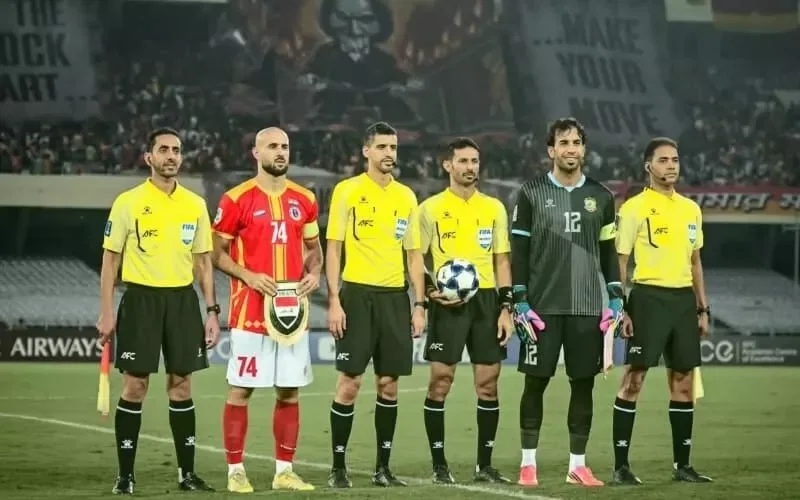
East Bengal FC 2-3 Al-Shorta: Key takeaways from AFC Champions League Two 2026-27 opener

A first-half brace from David Lalhlansanga had East Bengal ahead at the break
For 45 minutes, Salt Lake Stadium got the night it wanted. David Lalhlansanga scored twice, East Bengal FC responded by going level with a goal just before the break, and the plan looked sound. Then the second half began, and the match changed shape in about three minutes.
Hussein Ali Jasim Al Saedi levelled from Ahmed Yahya’s cross, and Kingsley Kuku headed in Cristian Barco’s corner at 53′. East Bengal were suddenly behind in a continental group game they could not afford to lose. Even a red card for Abdoul Moumouni, which left Al-Shorta with ten men, failed to change the direction of the evening.
The defining theme is not a lack of effort. It is how little East Bengal controlled once the match stopped following their script.
1. The third that never came
Catch Every Update, Anytime, Anywhere
East Bengal’s defeat was also a failure to finish. There were 9 on target attempts beyond the two Lalhlansanga goals, and none went in.
The costliest spell came just before the break. During the added time of the first half, East Bengal pressed for a third and had four attempts in four minutes. Edmund sent a shot from the centre of the box over the bar, and David tried a long-range effort that Jalal Hassan saved.
Anwar Ali headed a corner narrowly wide, and Edmund’s second attempt was blocked. A 3-1 lead at halftime would’ve changed the second half. Instead, it stayed 2-1, and Al-Shorta only needed one good start to the second half.
The pattern continued after the restart. David was denied again at 55′ from the centre, Mohammed Rashid dragged an effort just wide at 65′, and Jay Gupta’s header in the dying moments of the game was saved low. Even with a man advantage after Moumouni’s red card, East Bengal continued the pattern and failed to score.
The cost was clear by full time. East Bengal generated enough chances to win the match comfortably, but only two found the net. Al-Shorta needed far fewer chances to score three and win the game.
2. The restart: where the match turned

Al Saedi’s equaliser and Kuku’s goal came within about ten minutes of the restart. Neither was a long-range strike or a moment of individual brilliance. The first came from a cross into the centre of the goal, and the second from a corner delivered into the bottom-left.
Al-Shorta were not riding luck. They came out with intent and found East Bengal still adjusting to the break.
When a side concedes twice in quick succession after leading at half-time, the cause is usually more about concentration and emotional momentum than a tactical failure. East Bengal’s 2-1 lead did not appear to change how they defended the first ball into the box.
3. Set pieces: a recurring weakness

Three of Al-Shorta’s four goals followed a delivery from a dead ball or a similar crossing situation. Yahya’s first equaliser was a header from a Rubén Ramírez corner. Kuku’s 53′ winner was a header from Barco’s corner. Al Saedi’s goal, while not from a corner, was converted from close range after a cross.
East Bengal themselves threatened from corners, with Anwar Ali’s header drifting wide at 45+3′, so this was not one-sided. But Al-Shorta were more clinical at turning deliveries into goals. In a competition where margins are thin, marking at corners becomes the difference between a point and a defeat.
4. Kuku as the pivot

Kuku was involved in almost everything good Al-Shorta did. He won the first corner at 6′ with a run down the left, scored the winning goal, and was instrumental in the win. Even his set-up work for Al-Shorta’s attacks shows how often he was the reference point.
East Bengal did not appear to have a settled answer for him. His movement drew defenders out of shape, and his heading ability on the second goal was decisive. Matching a forward like that requires more than man-marking. It requires tracking him through transitions and at set pieces, and the evidence here suggests that did not consistently happen.
5. The red card that changed nothing

Moumouni was booked at 39′ and sent off after a second yellow in the second half. East Bengal had a numerical advantage for a significant stretch, and Habas responded by replacing the scorer of both goals, Lalhlansanga, with Lukasz Zwolinski at 79′.
The problem is conversion. After the red card, East Bengal created one real chance, Gupta’s 90+2′ header, which Hassan saved low. Meanwhile, Al-Shorta, playing with ten, wasted a good chance at 81′ when Yahya shot wide from point-blank range.
A numerical edge helps only if a side can turn possession into shots on target. That did not happen here, and the substitution of the match’s only scorer is a decision that will be debated.
6. The goalkeeper’s evening

Hassan made a string of saves that kept East Bengal from drawing level or retaking the lead, including a stop from Lalhlansanga at 55′, a fine save from Dani Ramírez’s effort aimed at the top corner at 40′, and the late stop from Gupta.
East Bengal produced chances, but the visiting keeper repeatedly denied them at key moments. At the other end, Prabhsukhan Gill made a comfortable save from Moumouni at 66′, but he could do little about the goals. The contrast in goalkeeping moments matters in a 3-2 scoreline that, for long stretches, was closer than the margin suggests.
For more updates, follow Khel Now on Facebook, Twitter, Instagram, Youtube; download the Khel Now Android App or IOS App and join our community on Whatsapp & Telegram.